AI temperature explained in practical terms: temperature changes how strongly a text generator favours its highest-scoring next tokens during sampling. Lower values concentrate the choices; higher values spread probability more widely. The setting changes variation in an answer, but it does not verify the answer’s facts.
Imagine asking an AI tool to draft several subject lines. You may want different wording on each attempt. Now imagine asking it to extract an invoice number. Variety in that output is less useful. Those jobs give you different reasons to inspect the generation settings.
Start with the next-token choice
A language model assigns scores to possible next tokens. A token may be a whole word, part of a word or punctuation. The decoding process turns the scores into a choice, adds the selected token to the sequence, and continues.
Hugging Face’s generation guide distinguishes greedy decoding from sampling. Greedy decoding chooses the most likely next token at each step. Sampling draws from a probability distribution, so a lower-ranked candidate can sometimes be selected.
That difference helps explain why the same prompt can produce different wording. Once one token changes, the text supplied to the next step changes too. A small early choice can lead to a different sentence or structure later.
What temperature changes
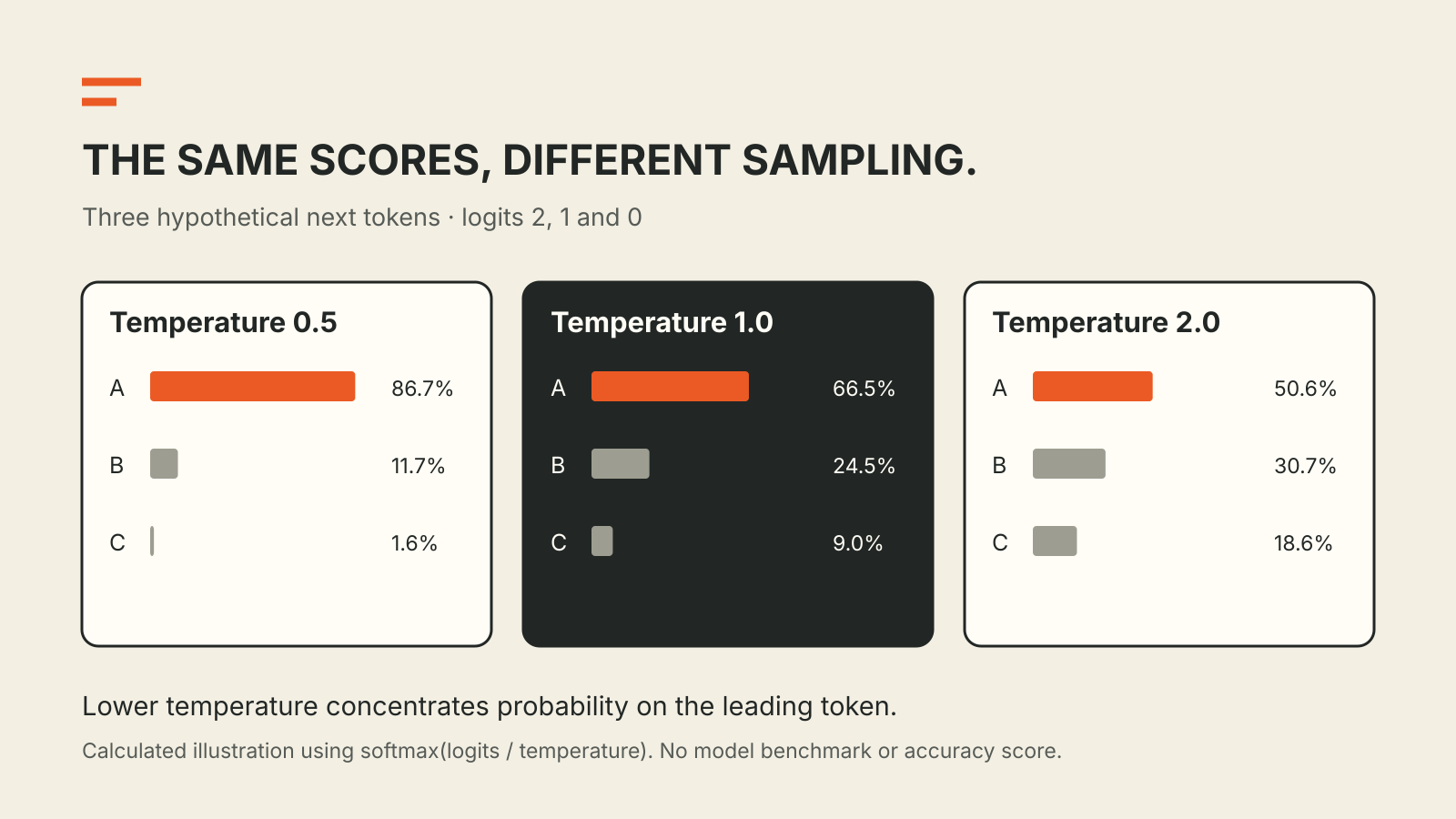
Temperature rescales the token scores before sampling. In the standard calculation, the logits are divided by temperature and converted to probabilities with softmax. A value below one sharpens the distribution around the leading candidates. A value above one flattens it.
Hugging Face’s TemperatureLogitsWarper reference describes this as controlling the randomness of predicted tokens. Its implementation requires a positive temperature, and the documentation warns that temperature has no effect unless sampling is enabled with do_sample=True.
For a small calculated illustration, give three hypothetical tokens scores of 2, 1 and 0. At temperature 1, their probabilities are approximately 66.5%, 24.5% and 9.0%. At temperature 0.5, the leading token receives about 86.7%; at temperature 2, it receives about 50.6%. These are calculations for invented scores, not measurements of a model.
The highest-ranked token remains highest-ranked in this example. What changes is how much room the other choices receive.
Lower temperature does not check a fact
A concentrated distribution can make repeated outputs more similar. It cannot establish that an address, price, quotation or legal rule is correct. If a model strongly favours an incorrect continuation, reducing the temperature can make that continuation more consistent.
For factual work, assess the evidence separately. Check whether the source supports the specific claim, whether its date fits the question and whether the answer adds details the source never supplied. Our explanation of why AI tools hallucinate covers that reliability problem.
The same distinction applies to structured extraction. A stable invoice number is useful only if it matches the document. Repetition alone does not establish accuracy.
Temperature and top-p control different stages
Top-p sampling, also called nucleus sampling, restricts the candidate set using cumulative probability. Hugging Face’s TopPLogitsWarper reference describes keeping the smallest set of the most probable tokens whose combined probability reaches the selected threshold.
Temperature changes the shape of the distribution. Top-p filters which candidates remain available. Because both can affect the eventual sample, changing both at once makes it harder to identify why an output changed.
For an evaluation, keep the model, prompt and other generation settings fixed while varying one control. Save the exact settings beside the results. Compare several outputs for the qualities the task needs, such as faithful extraction or useful wording variety, instead of judging one unusually good answer.
Check the tool before choosing a number
An interface may hide decoding settings, expose only a subset, or apply its own defaults. A parameter accepted by one library should not be assumed to have the same supported range in every hosted service. Check the documentation for the specific model and endpoint.
A setting labelled zero also needs interpretation. Hugging Face’s positive-temperature processor approaches greedy behaviour as temperature becomes very small, while greedy decoding is a separate strategy. Do not pass zero into an implementation that requires a positive number.
Temperature also cannot enlarge the text available to the model. For that limit, see context windows explained. Adding relevant source material and changing the sampling distribution solve different problems.