
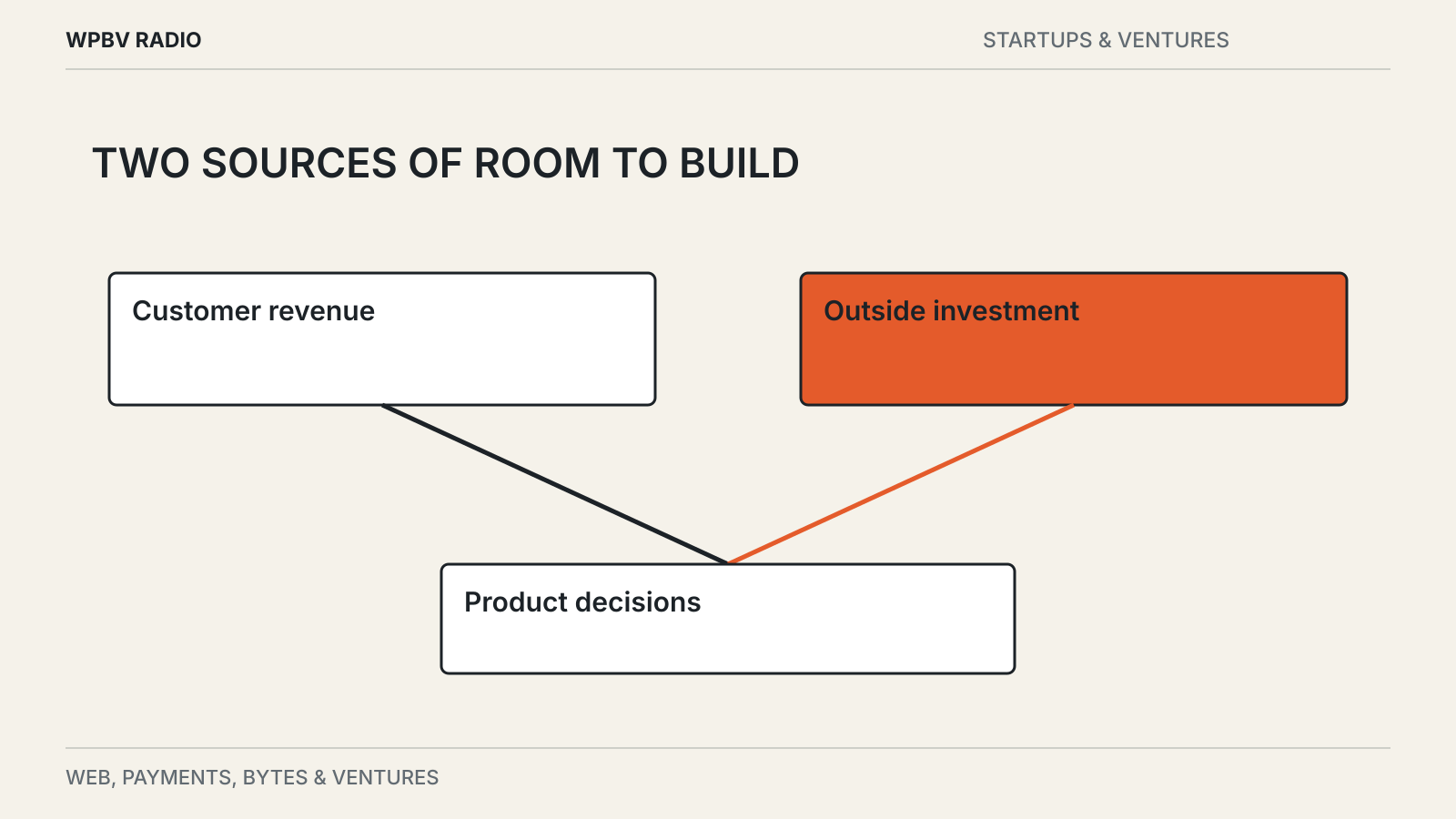
A small software company charges from day one and grows slowly. Another offers a generous free tier, hires quickly and announces a funding round before it has much revenue. Both can be rational choices under different financing arrangements.
Funding changes how long a company can wait for returns and whose expectations shape its decisions. It does not determine product quality by itself.
Customer cash sets one kind of timetable
A bootstrapped company generally relies on its founders’ resources, customer payments and internally generated cash rather than substantial outside equity financing. The exact mix varies; the label does not guarantee that the business has never used debt or other support.
When customer cash must cover current bills, pricing and retention become immediate concerns. A feature that helps people renew may take priority over an expansion that could produce revenue years later.
That constraint can encourage focus. It can also limit hiring, infrastructure and the ability to serve a large customer quickly. A small team still has to decide which promises it can support.
Investment can pay for work before demand catches up
Outside capital can fund development, distribution or infrastructure before the resulting revenue arrives. It can give a company time to tackle a problem that would be difficult to finance from early customers alone.
Investors receive rights defined by the financing documents and expect an eventual return. The precise rights and expectations differ. Y Combinator’s SAFE materials illustrate how even early financing uses specific conversion and ownership mechanics.
It is therefore too simple to say that investment means “growth at any cost.” But the scale of the expected outcome can influence which opportunities the company pursues and which smaller markets it leaves behind.
The business model can matter more than the label
A product sold through a self-service website has different costs from enterprise software requiring months of sales work, implementation and support.
Stripe’s SaaS business guide emphasizes how the selling model shapes a software company. Those economics exist whether the founders raised venture capital or funded the first version themselves.
A bootstrapped enterprise vendor may need careful cash management because a large contract pays slowly. A venture-backed self-service app may still build a disciplined, profitable customer relationship. The funding label is context, not a complete operating description.
Watch the choices users can see
Financing can appear in the product through pricing, support coverage and the pace of expansion. A company may add enterprise controls to win larger contracts, narrow a free plan or retire a feature that serves too few customers.
None of those decisions proves a company has abandoned its users. They do change whether the product remains a good fit for a particular person or team.
Look at the quality of the transition: notice periods, export options, migration help and clear pricing. Those are observable behaviors. A founder’s declaration of independence or an investor’s reputation is a weaker substitute for them.
Keep your own switching costs manageable
Whatever the financing model, avoid making the product’s continued existence your only recovery plan. Know how to export important data and understand which integrations or custom workflows would need rebuilding.
For a notes application, test the export before moving in. For a business service, examine the contract, support commitments and a practical migration route appropriate to your use.
Funding can increase a company’s ability to invest in the product. Customer revenue can give it freedom to set a narrower pace. Either route still requires competent execution and enough demand to sustain the service.