
A 409A valuation is the price a private company puts on one share of its common stock so it can grant stock options at fair market value. If an option’s strike price is below that value on the grant date, US tax rules treat the option as deferred compensation, and the employee can owe income tax at vesting plus a 20% additional tax. This guide covers how the value is set, how long it holds and what an employee can check, using the Treasury regulation itself.
This is an explanation of US tax rules, not tax or legal advice. The figures in the examples are illustrations, not data about any real company.
Why the strike price has to match fair market value
Section 409A of the tax code governs nonqualified deferred compensation. A stock option escapes it only if it meets the conditions in Treasury Regulation § 1.409A-1(b)(5). The first is that “the exercise price may never be less than the fair market value of the underlying stock … on the date the option is granted,” with the number of shares fixed at grant.
An option priced below that value, often called a discount option, falls inside section 409A. Incentive stock options face a parallel rule: section 422 requires an ISO’s price to be at least the stock’s fair market value at grant, as our guide to employee stock options vesting explains.
A public company can read its fair market value off the stock market. A private company has no market price, so it needs a valuation, and that is what founders, lawyers and employees mean by “a 409A.”
Three methods the IRS presumes are reasonable
The regulation lets a company use any reasonable method, but it names three methods that are presumed reasonable. The IRS can overturn the result only by showing the method or its application was “grossly unreasonable.” That shift in the burden of proof is why most startups use one of them:
- Independent appraisal. An appraisal of the stock as of a date no more than 12 months before the grant it is applied to.
- Binding formula. A formula price that also governs buybacks and sales to the company and its larger holders, used the same way for all of them. It is uncommon at venture-backed startups.
- Illiquid start-up valuation. A written report made reasonably and in good faith by a qualified person. It is open only to a company that has not conducted its business for 10 years or more, has no stock traded on an established market, and does not reasonably expect a sale of the company within 90 days or a public offering within 180 days. “Significant experience” here generally means at least five years in business valuation, financial accounting, investment banking, private equity, secured lending or comparable work.
Outside these methods a company can still defend its number, but without the presumption it carries the burden of showing the value was reasonable.
What a valuation has to weigh
The same section lists the factors a reasonable method considers, as applicable:
- the value of the company’s tangible and intangible assets;
- the present value of its expected future cash flows;
- the market value of stock in similar companies;
- recent arm’s-length transactions in the company’s own stock;
- control premiums or discounts for lack of marketability;
- whether the method is used for other purposes with a real economic effect on the company or its holders.
A method that ignores available information material to the company’s value is not reasonable, according to the regulation.
Why the common price sits below the preferred price
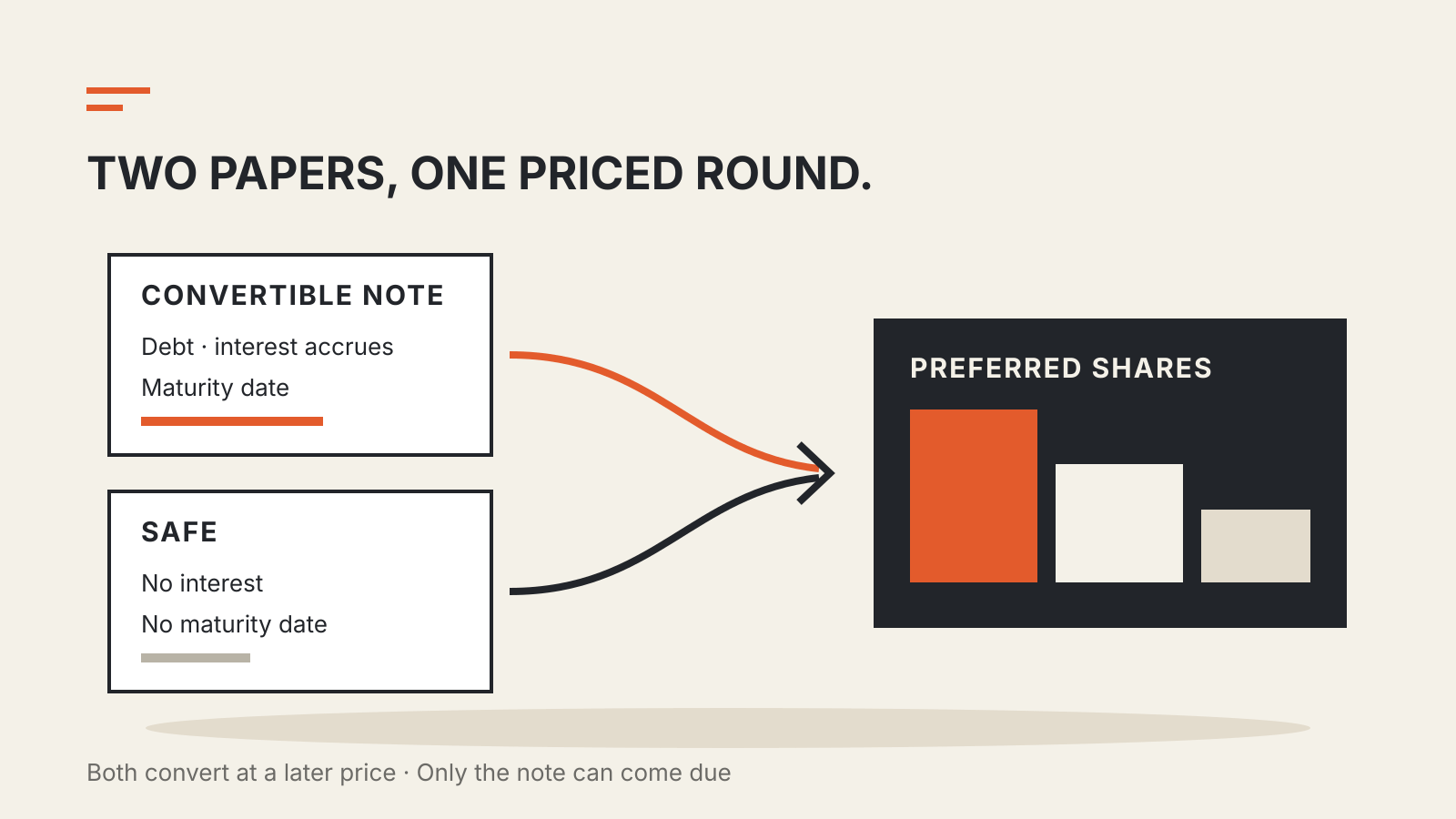
Founders often notice that the 409A price is well below what investors paid in the last round. The two prices are for different stock. Investors in a priced round usually buy preferred shares, which often carry a liquidation preference: in a sale, preferred holders are paid back first, and common stock gets what is left. Options are options on common stock.
The regulation’s list allows for that gap. It names discounts for lack of marketability, and common stock in a private company cannot be sold freely. It also names recent arm’s-length transactions, so a new round is evidence the valuation has to weigh, not a price it has to copy. The regulation sets no fixed ratio between common and preferred prices.
When a 409A valuation goes stale
A value that was reasonable on the valuation date stops being reasonable later in two cases, under § 1.409A-1(b)(5)(iv)(B)(1):
- the value was calculated as of a date more than 12 months before the date it is used for;
- it does not reflect information that became available after the calculation and may materially affect the company’s value. The regulation’s examples are the resolution of material litigation and the issuance of a patent.
Worked dates for one hypothetical company, with a valuation as of January 15, 2026:
- Grant on December 1, 2026. Ten and a half months later and nothing material has changed, so the value can still be used.
- Grant on February 1, 2027. More than 12 months after the valuation date. The old value is no longer reasonable, whatever happened in between.
- Grant on October 1, 2026, after a priced round closed on September 3. The round is new information about value, and recent arm’s-length transactions are on the regulation’s list of factors. If it may materially affect the value, the January number is not reasonable for this grant even though it is less than 12 months old.
That is why “how long is a 409A valuation good for” has two answers: at most 12 months, and less if something material happens first.
What a discount option can cost the employee
When a plan fails section 409A, 26 U.S.C. § 409A(a)(1) makes the deferred amount taxable in the year it is no longer subject to a substantial risk of forfeiture, which for options usually means the year they vest. The tax for that year then increases by two amounts: 20% of the amount included in income, and interest at the underpayment rate plus one percentage point. The person who includes the income, the employee, owes both.
Here is a simplified example. An employee receives 10,000 options with a $0.50 strike when a reasonable valuation would have put the common stock at $1.20. All of them vest in the same year, and the value is still $1.20:
- Spread on the vested options: 10,000 × ($1.20 − $0.50) = $7,000.
- That $7,000 is taxable income in the vesting year, even though nothing was sold.
- Additional tax: 20% × $7,000 = $1,400, on top of ordinary income tax.
- Interest at the underpayment rate plus one point runs on the tax that would have been due had the amount been taxed when first deferred or, if later, when it vested. In this one-year example that is little or nothing.
IRS rules measure the amount in more detail than this, and later years can bring further income inclusions while the options stay unexercised. The direction is clear: a strike set too low moves tax forward to vesting and adds a 20% charge to it.
What an employee can check in a grant
- The fair market value the grant notice or board approval states, and the date of the valuation it comes from.
- Whether that valuation date is within 12 months of the grant date.
- Whether a priced round, an acquisition offer or another material event happened between the valuation and the grant.
- Whether the grant is an ISO or a nonstatutory option, since both must be priced at fair market value but are taxed differently.
- What percentage of the company the options represent. A share count says little on its own, and the dilution calculator shows how later rounds change it.
A down round can also lower the common stock value, which can leave earlier grants with strikes above the current 409A price.