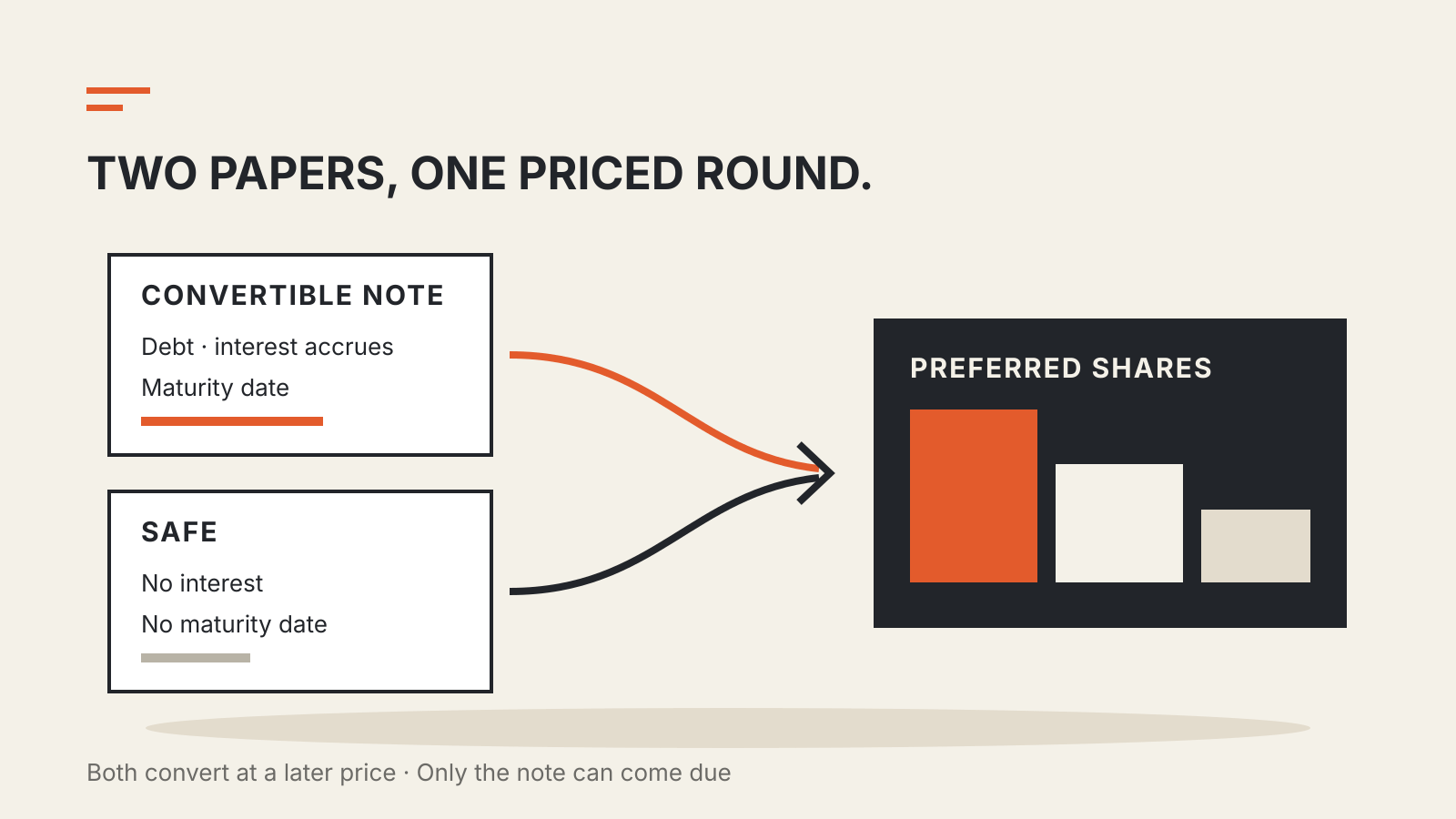
Convertible note vs SAFE comes down to one question: is the investor lending the startup money, or buying a right to shares later? A convertible note is a loan that is expected to turn into shares. A SAFE is not a loan at all.
Both are used when a young company wants seed money without agreeing on a share price yet. Both usually convert when the company sells preferred stock in a priced round. The differences sit in the clauses that apply if that round is late, small or never happens.
This is an explanation of the instruments, not legal or investment advice. The documents you sign are what count.
What each instrument is
The SEC’s guide to startup securities gives the plain definitions. A convertible note is “a loan made by an investor to a company that can be converted into a different security,” and it typically converts automatically into preferred stock when the next funding round closes. A SAFE, or simple agreement for future equity, is an agreement in which the company promises the investor a future ownership interest if certain triggering events occur, such as an equity financing or an acquisition.
The SEC adds that a SAFE holder has no ownership interest until a triggering event happens. Our SAFE valuation cap explainer covers how the cap sets the conversion price.
The three clauses that separate them
Y Combinator, which created the SAFE, publishes a side-by-side comparison of the two instruments and a priced round. Three rows matter most.
| Convertible note | SAFE | |
|---|---|---|
| Legal nature | Debt that converts to equity | Convertible security, not debt |
| Interest | Accrues; YC cites 2–8% as common | None |
| Maturity date | Yes; can force repayment or default | None |
| Rank if the company is sold or wound down | Senior: debt is repaid first | Behind debt, on par with preferred stock |
YC is an interested party, since it wrote the SAFE and uses it to fund its own startups, so read its comparison as one side’s framing. The structural facts in the table match the SEC’s definitions: one instrument is a loan, the other is not.
Interest: the note grows while it waits
Interest on a note typically accrues rather than being paid out along the way. In the note described below, accrued interest falls due at conversion, maturity or a sale, and on conversion it turns into shares together with the principal. The noteholder ends up with more shares than the original check alone would buy.
A real example: a crowdfunded convertible note filed with the SEC on EDGAR accrues interest at 4.0% a year, compounded annually. On a qualified financing of at least $1 million, the outstanding principal plus accrued interest converts at the lower of two prices: 80% of the price new investors pay, or a price based on a $3.5 million valuation cap.
Here is how interest changes the result, using simplified numbers that are not taken from any real deal:
- An investor puts in $100,000 on a note at 4% a year. A priced round closes 12 months later at $2.00 a share, and the note converts at a 20% discount, $1.60 a share.
- Principal plus interest is $104,000. Divided by $1.60, that is 65,000 shares.
- A SAFE for $100,000 with the same 20% discount and no interest converts into $100,000 ÷ $1.60 = 62,500 shares.
The 2,500-share difference is the interest. The longer the round takes, the bigger that gap. For how new shares dilute existing holders, try our dilution calculator.
Maturity: the clause founders feel
A maturity date is the point at which a loan comes due. The EDGAR note above lets investors demand repayment of principal and interest at any time from 24 months after closing if the note has not converted. YC’s comparison puts it bluntly: a maturity date “can force repayment or default.”
A startup that has not raised its next round by then may have little cash to repay with, so the right to demand payment gives noteholders leverage in any renegotiation of the note’s terms.
A SAFE has no maturity date, so there is no day on which the investor can demand the money back.
When conversion never comes
The SEC’s investor bulletin Be Cautious of SAFEs in Crowdfunding warns that a SAFE may never convert. If the company becomes profitable and never raises again, or raises money through a different instrument than the one the SAFE names as a trigger, the SAFE holder may be left with nothing. The same bulletin describes convertible notes as “essentially debt obligations,” with a promise of repayment and interest.
That is the trade-off in one line. A note gives the investor a creditor’s claim if the round never arrives. A SAFE gives the founder freedom from repayment, at the cost of more uncertainty for the investor.
Mixing the two
YC’s comparison warns founders against stacking a note on top of SAFEs: because debt ranks ahead of equity and convertible equity, SAFE investors automatically sit behind any noteholder in a sale or wind-down. When a company is sold, the order of payment then follows the preferences explained in our liquidation preference guide.