A tender offer lets eligible employees sell specified company shares during a defined offer, rather than waiting for an IPO or acquisition. It does not mean every employee can sell every award, or that an invitation guarantees a particular cash payment.
For employees reviewing one, the useful document is the actual offer package. Start with what can be sold, who is buying and how the amount reaching you will be determined. This is an explanation of the process, not a recommendation to sell or hold.
Identify the buyer and the shares
The SEC’s Investor.gov definition distinguishes an issuer buying its own securities from a third-party buyer. That is a more useful starting point than calling every transaction a company buyback.
Carta’s private-company guide describes employee liquidity programs with eligibility rules, permitted share classes and sale limits. A private company can organize a sale without becoming publicly traded.
Ask for the security’s exact name. A number in an equity dashboard is not a sufficient description of what the offer accepts. Put the eligible holding beside the grant or share record and resolve any mismatch before making a choice.
Our stock-options explainer covers vesting, exercise and the exercise window. Those questions should not disappear simply because a buyer has appeared.
Build a small offer worksheet
A useful worksheet separates confirmed terms from unanswered questions. It need not predict the company’s future value.
| Field to locate | Question it should answer |
|---|---|
| Eligible holding | Which shares or awards can I include? |
| Maximum sale | How much am I permitted to offer? |
| Price and currency | What is the agreed amount per accepted share? |
| Allocation method | What happens if sellers offer too many shares? |
| Deductions | What separates gross proceeds from cash received? |
| Deadline and settlement | When must I decide, and when is payment expected? |
Use the document’s wording for restrictions rather than paraphrasing them from a meeting. Record the date of the version you read. If a revised document changes a term, keep the versions identifiable.
For an unanswered item, write a question instead of treating a blank as zero or “not applicable.” This makes an employee information session more productive: you can ask about one condition, not whether the whole offer is good.
Distinguish the sale limit from allocation
Carta notes that an oversubscribed offer can reduce the number accepted from participating sellers. Read the particular allocation terms; do not assume your requested amount is the final accepted amount.
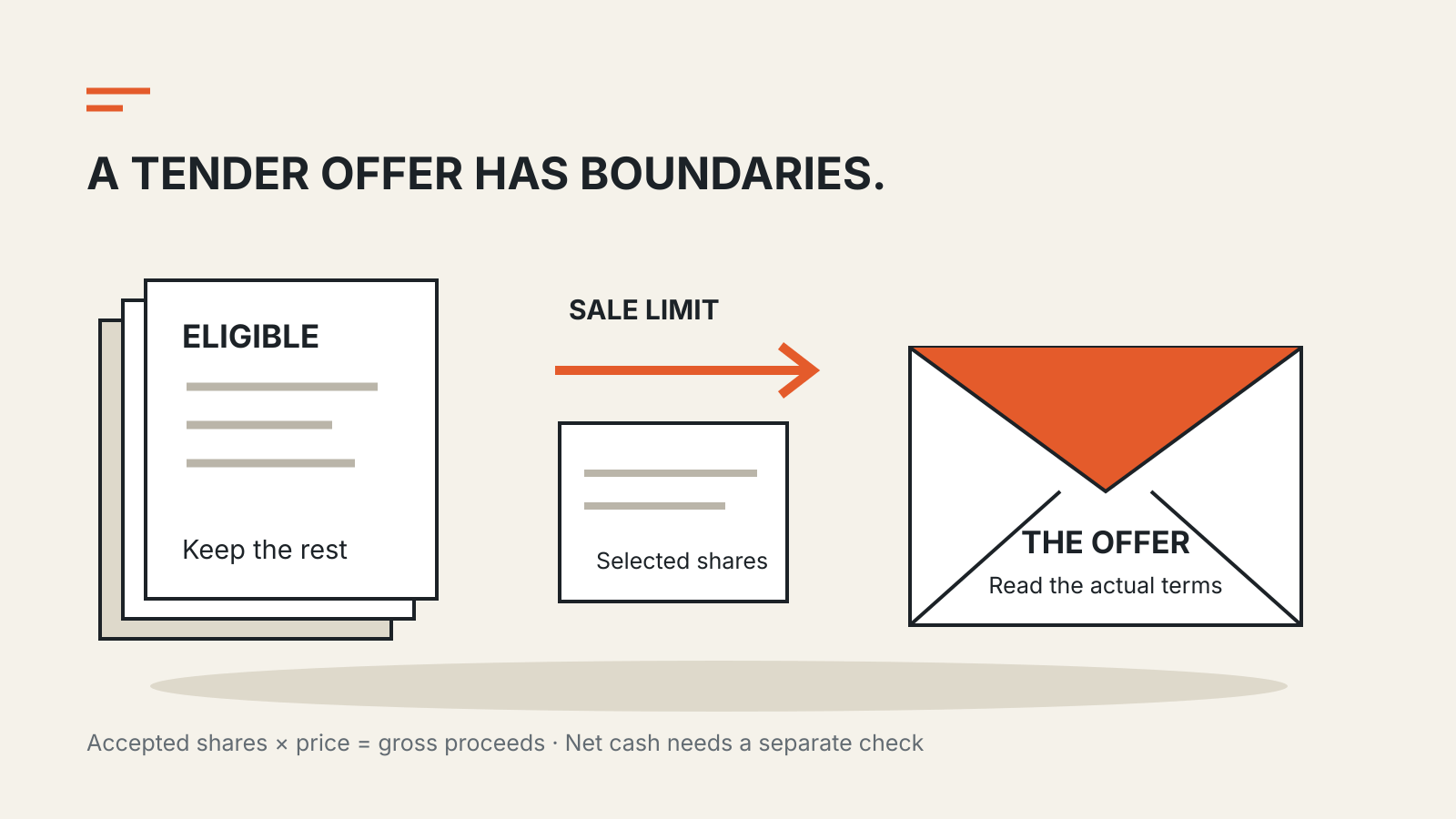
Consider a deliberately simplified example, not an actual offer. You have 1,000 eligible shares, are permitted to tender 200 and choose to tender all 200. At an illustrative price of $12, full acceptance produces $2,400 gross.
Now suppose the offer’s own allocation formula accepts only 75% of your tender. You sell 150 shares for $1,800 gross and retain 850 of the original 1,000. That is different from selling 200 shares at a lower price.
The 75% assumption is only for this calculation. Real programs can have different limits and allocation methods. Use the final acceptance notice, not this example, to establish how many shares actually changed hands.
Gross proceeds are not your spending balance
The same example establishes only share count multiplied by price. It does not calculate exercise costs, fees, withholding or final tax.
Ask the administrator for a reconciliation from accepted shares to expected cash, then take your own circumstances to a qualified tax or financial adviser. Carta explicitly notes that tax treatment depends on transaction structure and parameters; a colleague’s result is not your calculation.
A practical worksheet can show $1,800 gross and leave every unknown deduction clearly unresolved. Filling in an invented tax percentage would make the result look more complete while making it less useful.
Keep two questions separate: “What will be paid at settlement?” and “What will my final tax position be?” Obtain a documented answer to each where relevant.
Check the offer’s own protections and conditions
Investor.gov explains that the applicable US rules depend on the securities, bidder and issuer’s reporting status. Do not automatically apply a public-company rule to a private employee program.
The SEC’s mini-tender warning illustrates why names are not enough: different offers can have different disclosure and withdrawal protections. Its warning concerns mini-tenders, not a claim that every employee offer is one.
Locate the actual closing conditions, withdrawal terms and payment timing. Ask the administrator or securities counsel to explain unclear provisions in writing. This guide does not determine which legal regime applies to your offer or jurisdiction.
Decide what question the offer can answer
A tender provides a transaction on stated terms. It is not proof of an imminent IPO, a future valuation or another guaranteed chance to sell.
If you compare participation scenarios, show the accepted shares, gross proceeds and retained shares separately. Avoid treating the unsold balance as cash already available. The startup funding-round guide explains another common distinction between a financing headline and what an individual holder owns.