To read a blockchain transaction, check four things on a block explorer: the status (included and successful), who paid whom and how much, what the fee was, and how many blocks now sit on top of it. This guide reads two real transfers from the last two days, one on Ethereum and one on Bitcoin, field by field.
Checked November 27, 2026, with a public Ethereum node and the mempool.space API. Block counts and confirmations change every few seconds, so read them as a snapshot.
Start with the hash
Every transaction has a unique identifier. Ethereum calls it the transaction hash and Bitcoin calls it the txid. Paste it into any block explorer for that chain and you land on the transaction page. Explorers lay the same data out differently, but the fields come from the chain itself.
The two transfers below are ordinary payments, picked from recent blocks.
A real Ethereum transfer
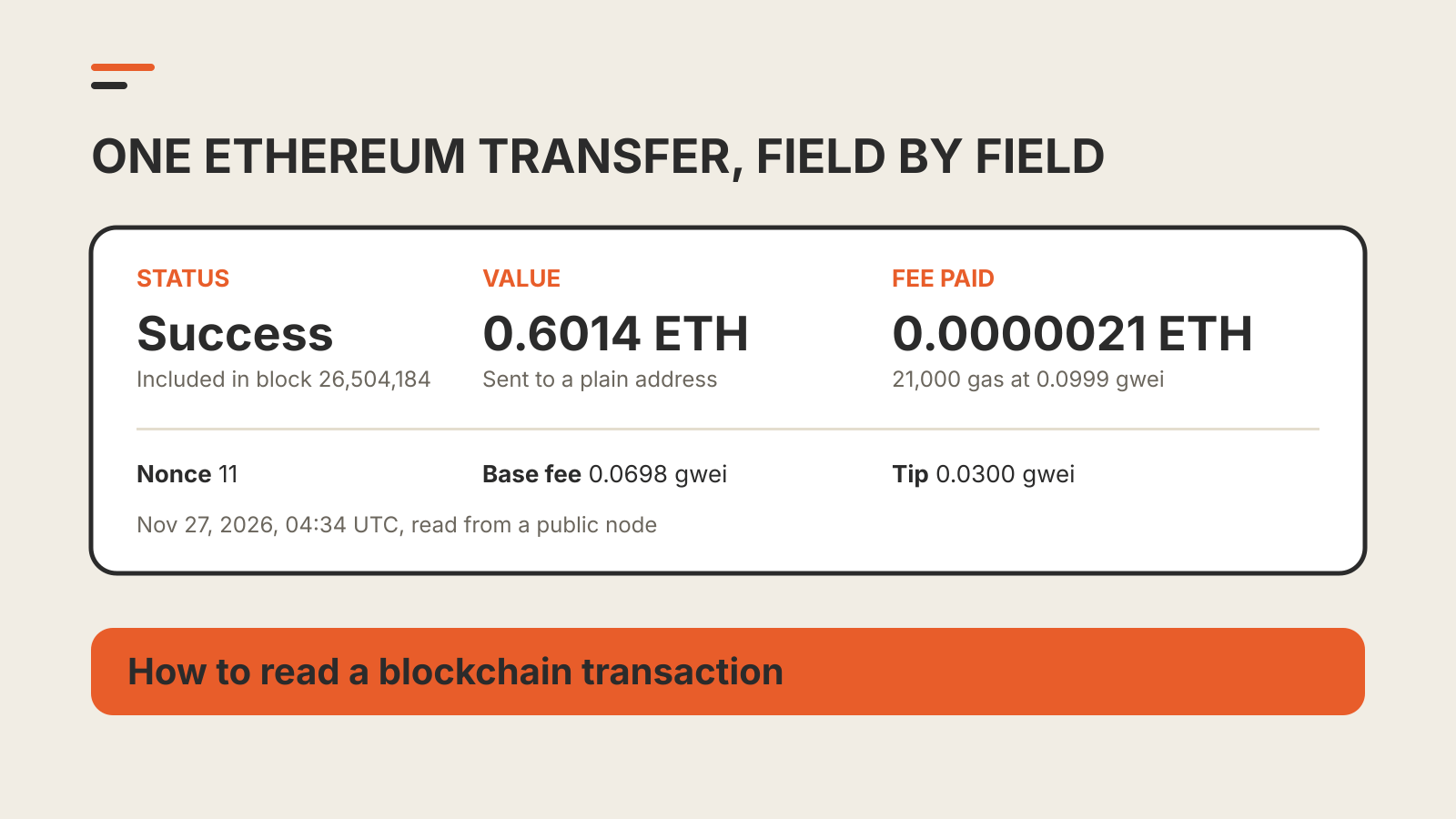
Hash: 0x53facb8b8c64cd1ffc88b4f81900356697c41186207a0a15c98e22d8d5bce975. It sits in block 26,504,184, which was produced on November 27, 2026 at 04:34 UTC, at position 74 in that block.
- Status: Success. The receipt shows status 1. A failed transaction still lands in a block and still pays for the work done, but it moves nothing.
- From and To. A plain wallet address sent the payment to another plain address. The call data is empty, which is how a simple transfer looks. A contract call would show data here.
- Value: 0.6014 ETH. The node reports it in wei (1 ETH is 10^18 wei); explorers convert it.
- Nonce: 11. The nonce is the sender’s own counter. This was the account’s twelfth transaction (counting starts at 0). Nonces must be used in order, which is why one stuck transaction can hold up the ones behind it.
- Gas limit and gas used: 21,000 each. 21,000 is the fixed cost of a plain ETH transfer. The sender had set the limit to exactly that, and all of it was used.
- Fee: 0.0000021 ETH. The transaction capped its fee at 0.0999 gwei per unit of gas and set its tip to the same figure, so the cap was the price. The block’s base fee was 0.0698 gwei, so the sender paid a tip of 0.0300 gwei on top. At 21,000 gas that is about 0.00000147 ETH burned as base fee and 0.00000063 ETH paid to the block producer.
- Type 2. This is the EIP-1559 format, with a maximum fee and a priority fee instead of one gas price.
When the page was checked, the chain had added about 300 blocks on top, and the node reported the block as finalized. For what finality means on each chain, see our guide to blockchain finality. For what drives the fee figure, see crypto gas fees.
A real Bitcoin transfer
Txid: 688844ac65f43757d97145629c6bdd40e2072e22f3efd3bf995ce6350459c5d7. It was confirmed in block 977,700, mined on November 26, 2026 at about 18:50 UTC.
Bitcoin has no account balance and no “from” field. A transaction spends earlier outputs and creates new ones, so the page lists inputs and outputs instead.
- One input: 3,207,591 satoshis. It spends an output that paid a native SegWit address (one starting with bc1q).
- Two outputs: 199,515 and 3,001,026 satoshis. One is usually the payment and the other the change returned to the sender. The chain does not label which is which.
- Fee: 7,050 satoshis. There is no fee field. The fee is what is left when outputs are subtracted from inputs: 3,207,591 minus 199,515 minus 3,001,026 is 7,050.
- Size: 561 weight units, or 141 virtual bytes. Bitcoin prices by size, not by amount. Dividing the fee by that size gives about 50 satoshis per virtual byte, the figure wallets quote. Moving ten times as much would have cost the same fee. For how those fees compete, see our mempool guide.
- Locktime: 977,699. This is the block height before the one the transaction landed in. Wallets set it on purpose so the transaction cannot be placed in an older, re-mined block. The technique is called anti fee sniping.
- Confirmations. One confirmation means the transaction is in a block, and each later block adds one. When checked, this one had 62.
What the two chains show differently
- Accounts or outputs. Ethereum shows a sender, a receiver and a nonce. Bitcoin shows inputs and outputs and no balances.
- Fee unit. Ethereum charges per unit of gas used. Bitcoin charges per byte of transaction size.
- Fee destination. On Ethereum the base fee is burned and the tip goes to the block producer. On Bitcoin the whole fee goes to the miner.
- Failure. An Ethereum transaction can be included and still fail. A Bitcoin transaction is either valid and included or not in a block at all.
A checklist before you trust a page
- Copy the hash from your own wallet or the sender, not from a message or link someone sent you.
- Check that the network matches the one you used. The same address can exist on several networks.
- Read the status first. “Pending” means not in a block yet.
- Compare the receiving address with the one you intended, character by character.
- For large amounts, wait for more blocks than one before treating the payment as final.