Crypto gas fees explained through an Ethereum transaction start with two separate quantities: the work performed and the price paid for each unit of that work. A transfer amount is not enough to calculate the network bill. Two transactions moving the same value can therefore have different fees.
This explainer concerns Ethereum’s layer-1 execution fees under EIP-1559. It is not a live price table, a wallet setup guide or a rule for every blockchain.
Separate the meter from the unit price
Ethereum’s developer documentation defines gas as a measure of computational effort. The fee is gas used multiplied by the effective price per gas. ETH pays that charge; gwei is a smaller denomination, equal to one-billionth of an ETH.
That distinction gives you a useful reading method. When comparing two receipts, put gas used in one column and price per gas in another. A higher total does not, by itself, tell you whether the operation required more work or the same work became more expensive.
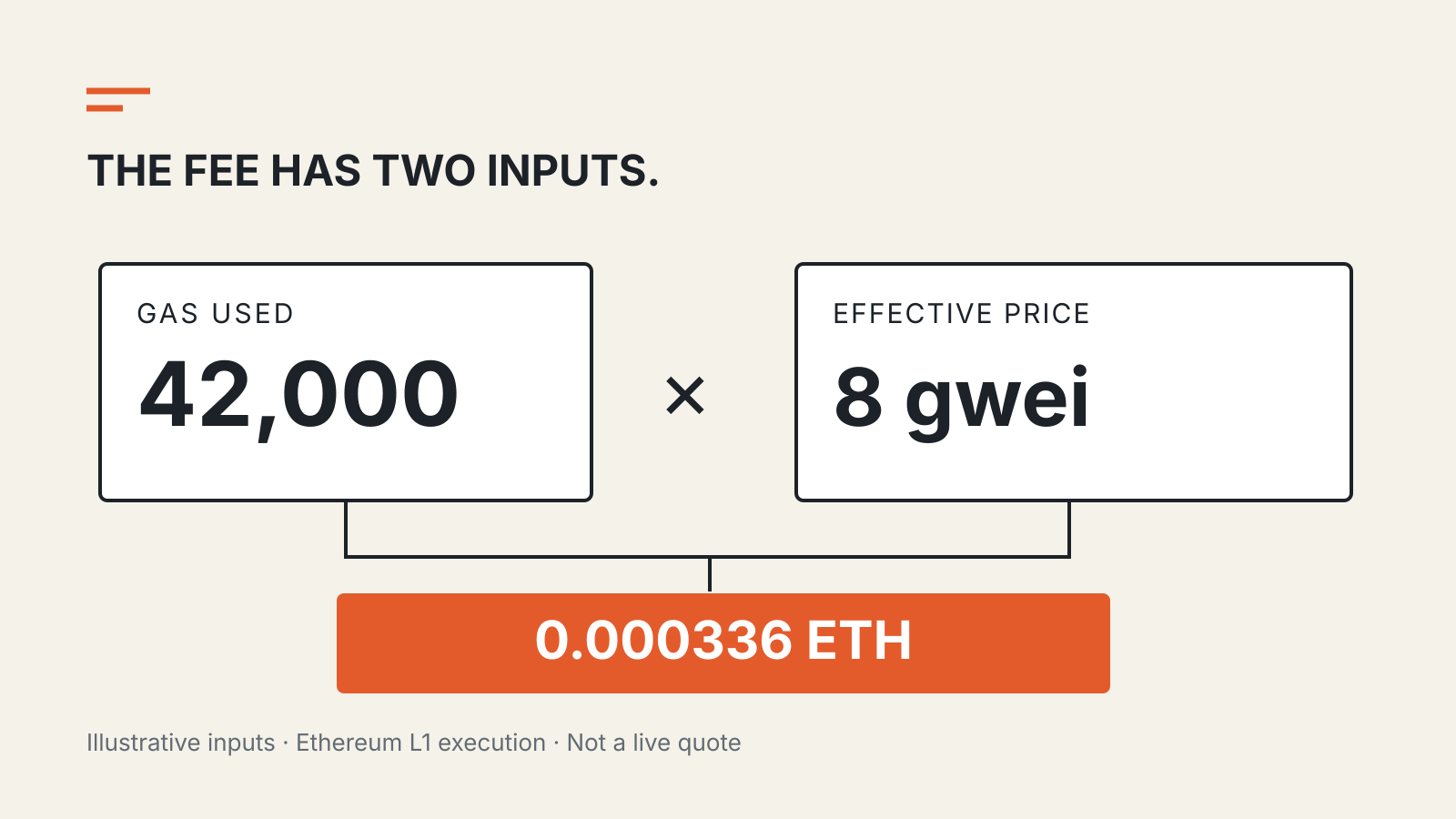
Imagine two hypothetical operations. Both use 42,000 gas. The first pays 8 gwei per gas and the second pays 16:
| Illustrative operation | Gas used | Effective price | Execution fee |
|---|---|---|---|
| A | 42,000 | 8 gwei | 0.000336 ETH |
| B | 42,000 | 16 gwei | 0.000672 ETH |
These are invented inputs for arithmetic, not observed transactions or current quotes. The second bill doubles without any increase in the assumed work. Multiplying either result by an ETH exchange rate would introduce another variable; this example deliberately leaves that out.
Read the base fee and tip together
EIP-1559 separates a protocol-set base fee from a priority fee. The base fee changes with block demand and is burned; the priority component rewards the block producer.
The transaction also carries a maximum fee per gas and a maximum priority fee per gas. The effective priority component cannot exceed the room left after the base fee within that maximum. A ceiling is therefore not the same thing as the final unit price.
For example, assume a base fee of 6 gwei, a maximum priority fee of 2 and a maximum total of 15. The effective price is 8 gwei, not 15. At 42,000 gas, the illustrative execution charge is the first row above. The unused headroom is not an extra service charge.
Keep these labels distinct when explaining a screenshot to someone else. “The wallet showed 15” is incomplete without saying whether that number was a per-gas ceiling, an estimated total or something else.
A gas limit is not a discount control
The gas limit caps the units an operation may consume. It is different from a price per unit. Ethereum documents that running out during execution can revert the operation while consuming the gas supplied for work already performed.
Lowering that limit arbitrarily is not a reliable way to make the same task cheaper. Before changing anything, identify which field is a quantity and which is a price. If you cannot explain the field, leave the transaction unsigned while investigating rather than experimenting with funds.
A failed operation also needs a precise description. Rejected before inclusion, pending, and executed unsuccessfully are different states. Do not infer the charge from a generic red error message.
An estimate is a decision aid, not a reservation
MetaMask’s fee explanation describes estimates based on current network conditions and recent tips. Its account also distinguishes layer-2 execution and data-settlement costs from the layer-1 case.
When recording a comparison, keep the network, operation and observation time beside the estimate. Otherwise, two apparently conflicting numbers may describe different jobs. There is no useful universal promise that a particular weekday or tip will guarantee the lowest price.
A cheaper route deserves a separate assessment, not just a smaller number on a screen. Our Ethereum layer-2 explainer covers that distinction; the bridge guide explains why moving between networks adds its own questions.
Compare the right bill
For a receipt review, write down the network, transaction status, gas used and effective gas price. Keep the amount transferred separate. If a service presents another fee, identify it separately instead of assuming every deduction is gas.
That produces a narrow answer you can check: what this execution cost on this network. It does not establish that a token is safe, that the application is trustworthy or that a payment has reached its final state. For the last question, read blockchain finality.