A transaction that feels expensive on Ethereum may cost much less on a layer 2 network. The difference comes from how the work is organized, not from making all the underlying work disappear.
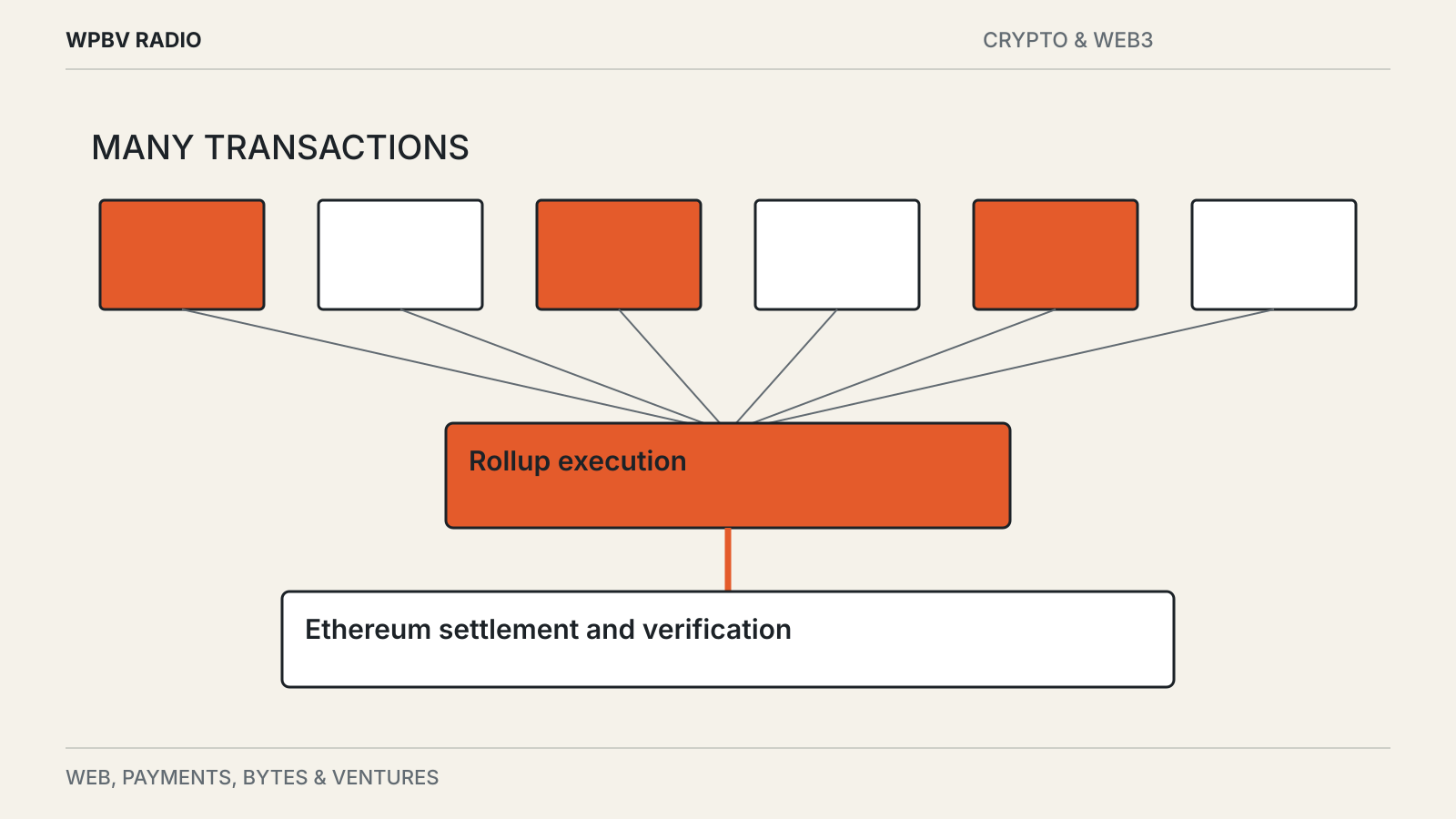
Layer 2 is a broad label. For Ethereum rollups, the basic idea is to execute transactions away from the main chain while using Ethereum for parts of the security and settlement process. Many users share costs that would otherwise be paid separately.
What a rollup moves
A blockchain transaction involves execution, records of the resulting state and a way to verify that the rules were followed. Rollups move much of the execution work off Ethereum’s main chain and submit information that supports verification and settlement.
Ethereum’s layer 2 overview explains the distinction between rollups and other scaling approaches. It also describes different proof mechanisms. The details matter because “uses Ethereum” can mean different things across networks.
For a reader comparing payment routes, the useful starting question is simpler: where does the transaction execute, where is the necessary data available and how can a user recover funds if an operator stops cooperating?
Lower cost does not mean a fixed fee
The price of a transaction can include execution costs on the layer 2 and its share of costs associated with Ethereum. Network demand and the size or complexity of the operation still matter.
A simple transfer and a multi-step swap do not consume the same resources. A quoted fee also describes conditions at a particular time. Treat a screenshot of a very cheap transaction as one observation, not a permanent price list.
Wallets and applications may add their own service fees or conversion costs. Compare the amount the recipient actually gets and the route needed to use it. Our stablecoin payment guide follows those additional costs.
A bridge changes the route and the risks
Moving assets between networks often involves a bridge or a service that provides liquidity on the destination. Different mechanisms can have different security assumptions, supported assets, limits and withdrawal times.
A token shown on a layer 2 may be the canonical representation supported by a particular bridge, or another wrapped asset. A similar name and symbol do not prove that two tokens have the same issuer or redemption route.
Before moving funds, confirm the network and asset supported by the recipient. Read the bridge’s documentation for deposits, withdrawals and what happens during a disruption. A fast third-party exit and the network’s standard withdrawal mechanism may involve different costs and counterparties.
Settlement and a wallet confirmation are not identical
An application may show a transaction as successful before every settlement or withdrawal condition has completed. This can be useful for a responsive interface, but the status label needs context.
Some rollup designs involve challenge processes; others rely on validity proofs. Operator arrangements, upgrade permissions and escape mechanisms also vary. Avoid treating every network marketed as a layer 2 as equally mature.
For a small everyday transaction, these details may remain invisible. They become much more important when transferring a large balance, integrating a payment service or depending on a rapid exit to another network.
Use a route you can explain
Before committing funds, write down the starting asset, destination network, expected receiving asset and planned exit. Add all visible fees and any withdrawal delay stated by the service.
Check whether the wallet has the correct network configuration and enough of the required fee asset, unless the application explicitly handles fees for you. Keep transaction references for each stage rather than relying on a single success screen.
A lower transaction cost is valuable. It should sit alongside a clear understanding of the permissions and recovery path. The wallet approval guide covers the other important part of using an unfamiliar application.