
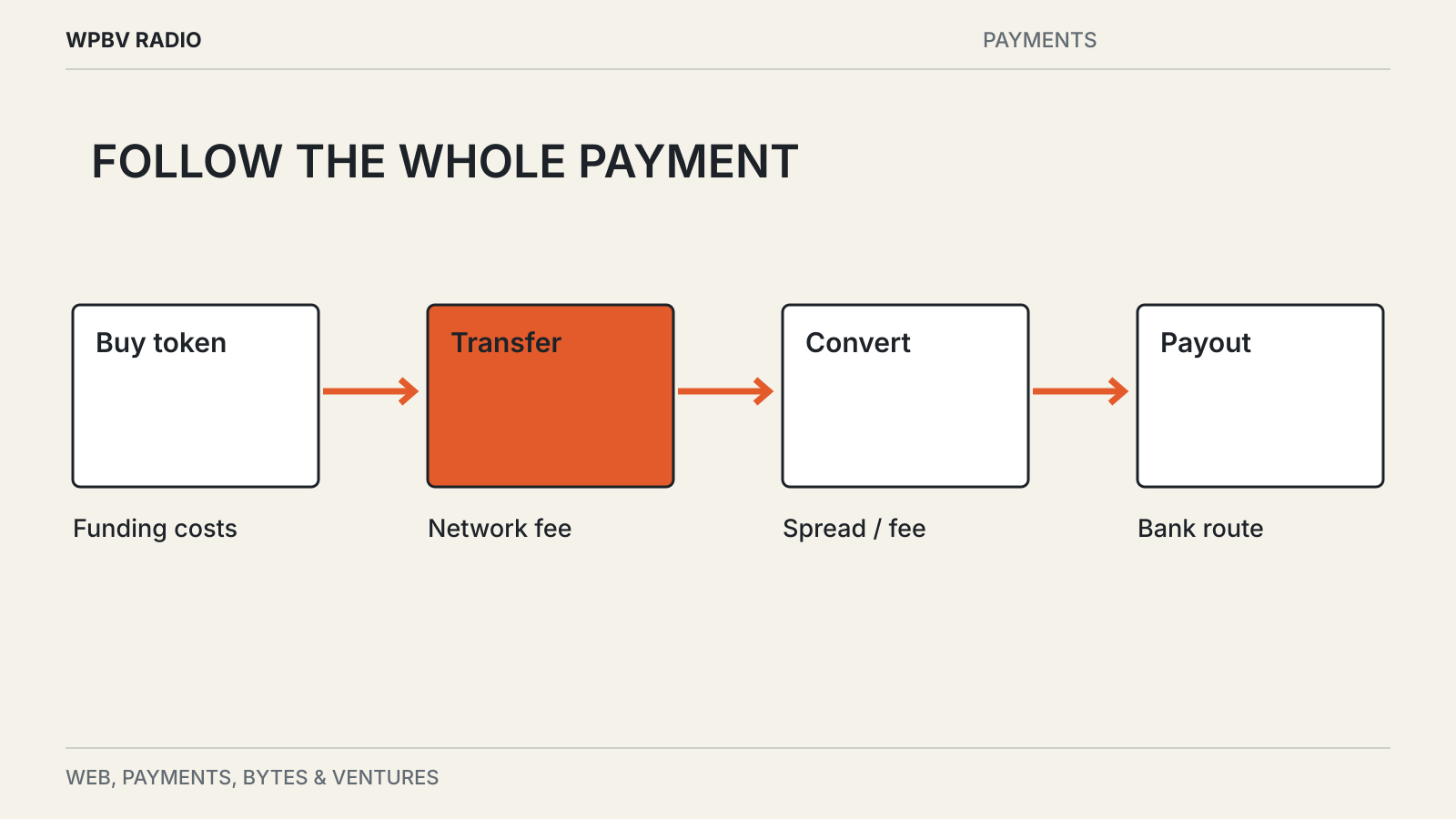
A stablecoin transfer can carry a small network fee while the complete payment costs considerably more. The difference is usually in the starting point, destination and services wrapped around the transfer.
A customer holding a supported token in a compatible wallet has a different journey from a customer buying that token with a card. A merchant keeping the token has a different journey from one expecting local currency in a bank account. Compare the entire route before comparing the price.
Draw the route first
Consider a hypothetical customer paying an overseas merchant. The customer buys a stablecoin, sends it on a blockchain and the merchant converts the proceeds into bank money. There may be charges at all three stages.
The purchase can include a provider fee and an exchange-rate spread. The blockchain transaction has a network cost. The merchant’s processor may charge for accepting, checking, converting or paying out the funds.
Some services combine those costs into one quoted price. Others show only their own fee. Neither presentation tells you the final cost until you know what amount leaves the payer and what amount reaches the recipient.
Network fees pay for the on-chain step
A blockchain fee pays for processing a transaction on that network. Its size depends on the network and transaction, including demand and the resources consumed. It is not automatically a percentage of the purchase.
The token used for payment and the asset used to pay network fees may differ. A service can sponsor or abstract away that fee, so the customer does not have to manage it directly. That changes who pays or how the charge appears; it does not mean the underlying work has no cost.
A token on one network is not interchangeable with a deposit address on another. Confirm the supported asset and network together. Our wallet guide explains why the network matters even when token names look familiar.
A processor can sell a more complete service
A merchant may want a familiar checkout, payment status, accounting records, refunds and bank settlement. Those features create operational work beyond broadcasting a transaction.
For example, Stripe’s stablecoin payment documentation describes a product in which accepted stablecoin payments settle into the merchant’s Stripe balance in US dollars. The documentation also sets merchant eligibility and supported network requirements. That is a particular service configuration, not a rule for all stablecoin payments.
When evaluating an offer, ask whether the quoted fee covers conversion and payout. Check the settlement currency, minimum payout, refund process and treatment of network costs. Verify current eligibility directly; availability can differ by country and account.
Compare amounts rather than slogans
Here is an illustrative calculation, not a provider quote. A customer spends $100 acquiring and sending a token. If conversion and transfer charges total $2, only $98 of value remains before any merchant-side costs. A cheap final blockchain transaction cannot erase the earlier $2.
For an international payment, the exchange rate may matter more than the visible fee. Compare how much local currency the recipient receives at the same time, using the same funding method. Also compare the delivery time and what happens if the payment needs to be returned.
A stablecoin’s target value is another distinction. “Designed to track a currency” is different from an unconditional promise that every holder can redeem through every provider at any time. Issuer arrangements, market conditions and the chosen service affect the practical route back to bank money.