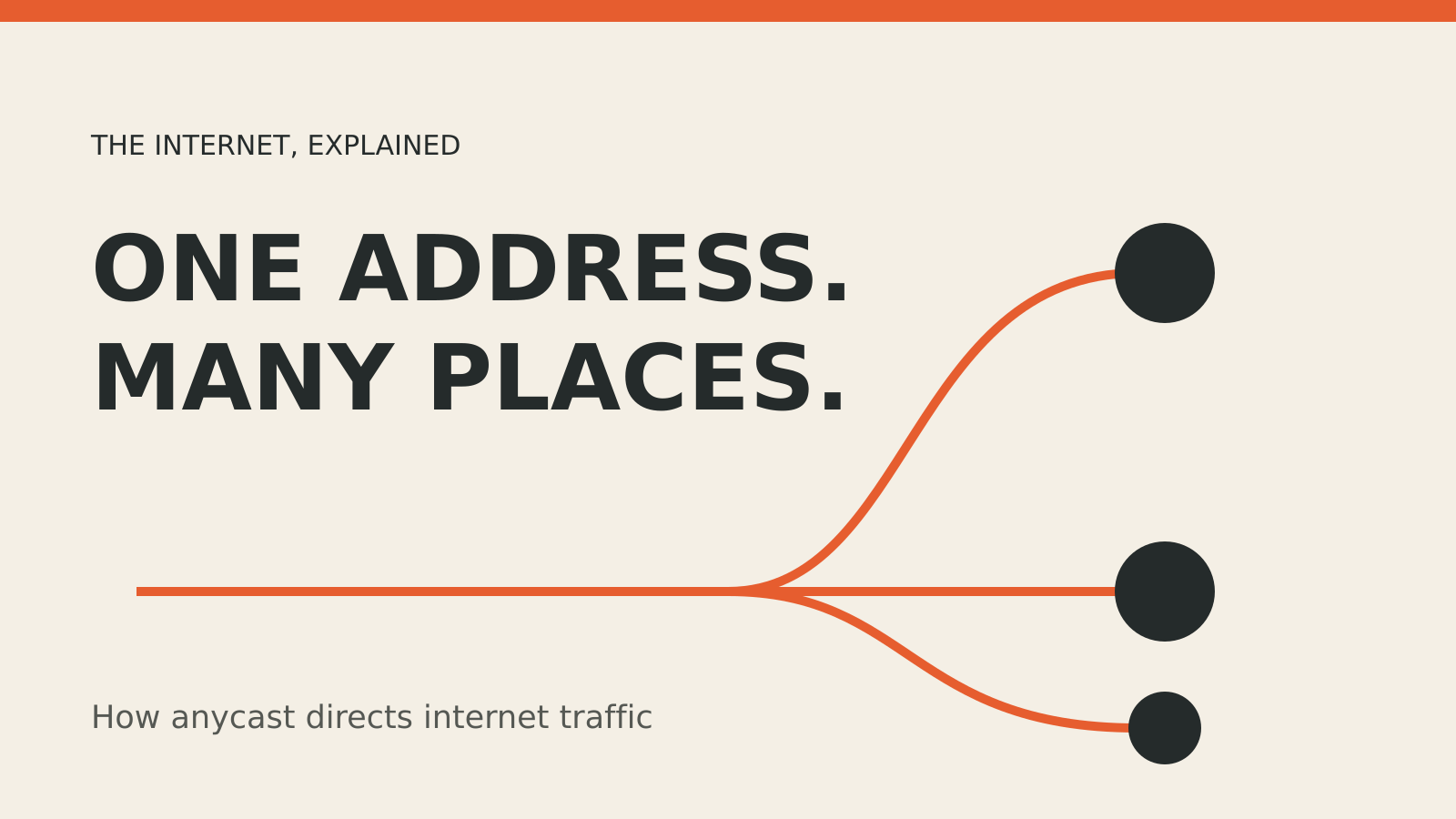
Anycast lets several servers in different places use the same IP address. When you send a request to that address, internet routing directs it toward one of the available locations. The result can be a shorter trip and a service that has more than one place to receive traffic—but neither outcome is guaranteed.
One address, multiple destinations
Imagine a service with servers in several cities. Each site announces a route to the same address range. Networks exchange those announcements using the Border Gateway Protocol, or BGP, and choose a path according to their routing policies. A request arriving from one network may reach a different location than a request from another.
That is the essential difference from a typical unicast setup, in which an address identifies one destination. Anycast identifies a group of possible destinations and leaves routing to select one. For a closer look at the route announcements behind this decision, see our BGP explainer.
Does the request always reach the nearest server?
No. “Nearest” in routing is not necessarily the shortest distance on a map. The selected route depends on connectivity, business relationships and network policy. Two people in the same city can follow different routes, and the chosen path can change as networks update their routing information.
A content delivery network can use anycast to bring requests to one of its edge locations before serving cached content or fetching it from an origin server. Our CDN guide explains the cache side of that process. Anycast handles how traffic reaches a location; it does not itself guarantee that the content is cached there.
What happens when a location fails?
An operator can stop announcing a route from an unavailable location, allowing traffic to find another advertised route. This can make a service more resilient, but recovery is not instantaneous and depends on the failure being detected and routing changes spreading.
Existing connections can also be affected. If a route changes during a session, later packets might reach a different server that does not have the original connection state. The Internet Engineering Task Force discusses these operational trade-offs in RFC 4786. Operators need to design for them rather than assume anycast makes every outage invisible.
Where is anycast useful?
DNS services and content delivery networks are common examples. A DNS query can be directed to one of several servers advertising the same address. A CDN can similarly receive a web request at an available edge location. In both cases, the service must still operate and synchronize its infrastructure appropriately.
Anycast is also distinct from DNS-based distribution. DNS can give users different IP addresses; anycast can route requests for the same IP address to different locations. A provider may combine the two approaches.
Questions readers ask
Is anycast a physical network?
Anycast is a routing approach, not a separate cable or device. It uses ordinary internet routing announcements to make an address reachable from multiple locations.
Does anycast always make a website faster?
No. It may reduce network distance for some users, but performance also depends on the selected route, congestion, server capacity and whether content is cached. Cloudflare describes how edge locations and routing fit together in its CDN reference architecture.
Is anycast the same as load balancing?
Both can distribute traffic, but they work at different points. Anycast steers traffic through network routing; a load balancer can choose among servers within a site or service. Operators often use them together.
Sources: IETF RFC 4786: Operation of Anycast Services; Cloudflare CDN reference architecture.