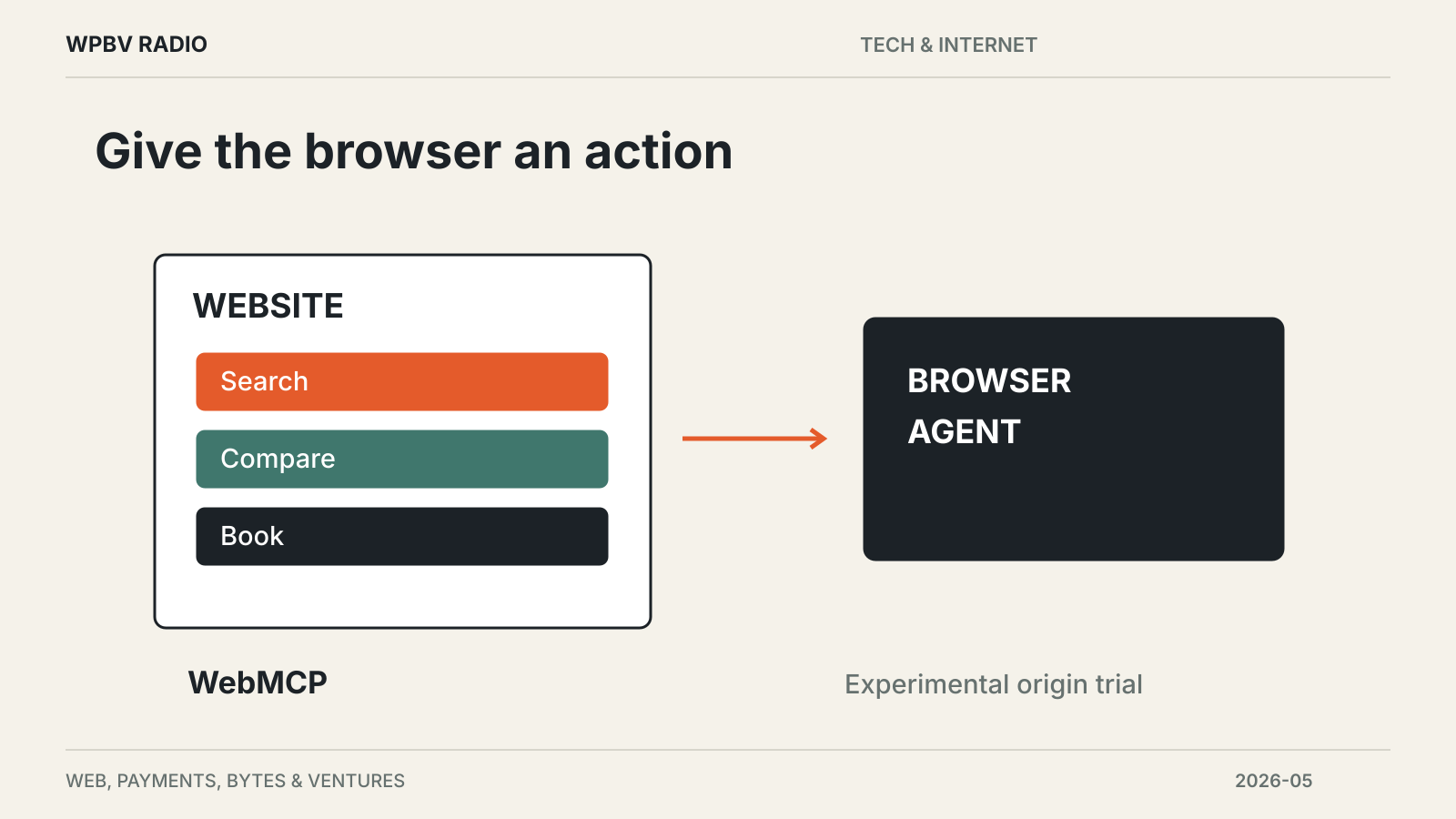
Google previewed WebMCP at I/O on May 19, describing a proposed web standard that lets websites expose structured tools to browser-based agents. An experimental origin trial is due to start in Chrome 149. The approach gives an agent explicit functions or forms to use, instead of requiring it to infer every action from a page’s visible interface.
The Chrome team’s I/O announcement places WebMCP alongside developer tools and browser AI updates. It describes an experiment, not a standard already implemented across every browser.
Websites can describe actions explicitly
A web application often knows exactly what a form does and which inputs it needs. An agent looking at a page has to discover that structure through the interface. WebMCP aims to let a site expose a more direct, machine-readable route to selected actions.
For a travel application, for example, a structured tool could make an itinerary request easier to express consistently. The application would still need to validate the request, apply the user’s permissions and decide which operations require approval.
Making an action easier to invoke does not make it appropriate in every context. A booking, a search and a deletion carry different consequences even when their interfaces look equally simple to software.
A trial leaves compatibility work ahead
Google says Gemini in Chrome will support WebMCP APIs in a future update. That wording matters for developers planning a production feature: both the browser interface and the agent consuming it have availability constraints.
The same I/O post introduces Modern Web Guidance in early preview and describes wider access to Chrome DevTools for agents. Together, the announcements show Google adding structured information on both sides of web development: helping agents interact with sites and helping coding agents inspect the sites they build.
A website considering WebMCP can begin with a narrow action that has clear inputs and an observable result. Its ordinary user interface remains important while browser and agent support develop.
More coverage of browser infrastructure is available from the Tech & Internet desk.