Interchange is the fee an acquiring bank pays a card issuer for a card transaction. It is usually one component of the merchant service charge, not the merchant’s whole payment bill. That distinction matters when comparing caps: a statutory ceiling on interchange does not automatically cap processor markup, network fees or every type of card.
The rules also use different shapes. The European Union limits certain consumer-card transactions by percentage. The United States applies a cents-plus-percentage formula to covered debit issuers. Canada negotiated lower credit interchange rates for qualifying small businesses. Australia uses separate limits for debit, prepaid, consumer credit and commercial credit.
Rules and official guidance reviewed November 1, 2026. This is a practical comparison, not legal advice. Check the current rule and your acquiring statement before estimating costs.
Start with the fee stack
A typical merchant card fee can include interchange, card-network assessments and the acquirer’s or processor’s own charges. Interchange usually passes from the acquirer to the issuer. The merchant normally sees a bundled or itemized merchant discount rate.
That is why a 0.3% interchange cap does not mean the merchant’s final fee must be 0.3%. Our guide to interchange fee versus merchant discount rate separates those layers. A processor may also price transactions with a flat fee, a monthly charge or a blended percentage.
Before comparing countries, identify four details: consumer or commercial card, debit or credit, domestic or cross-border transaction, and whether the issuer or merchant qualifies for an exemption or special program.
European Union: percentage caps for consumer cards
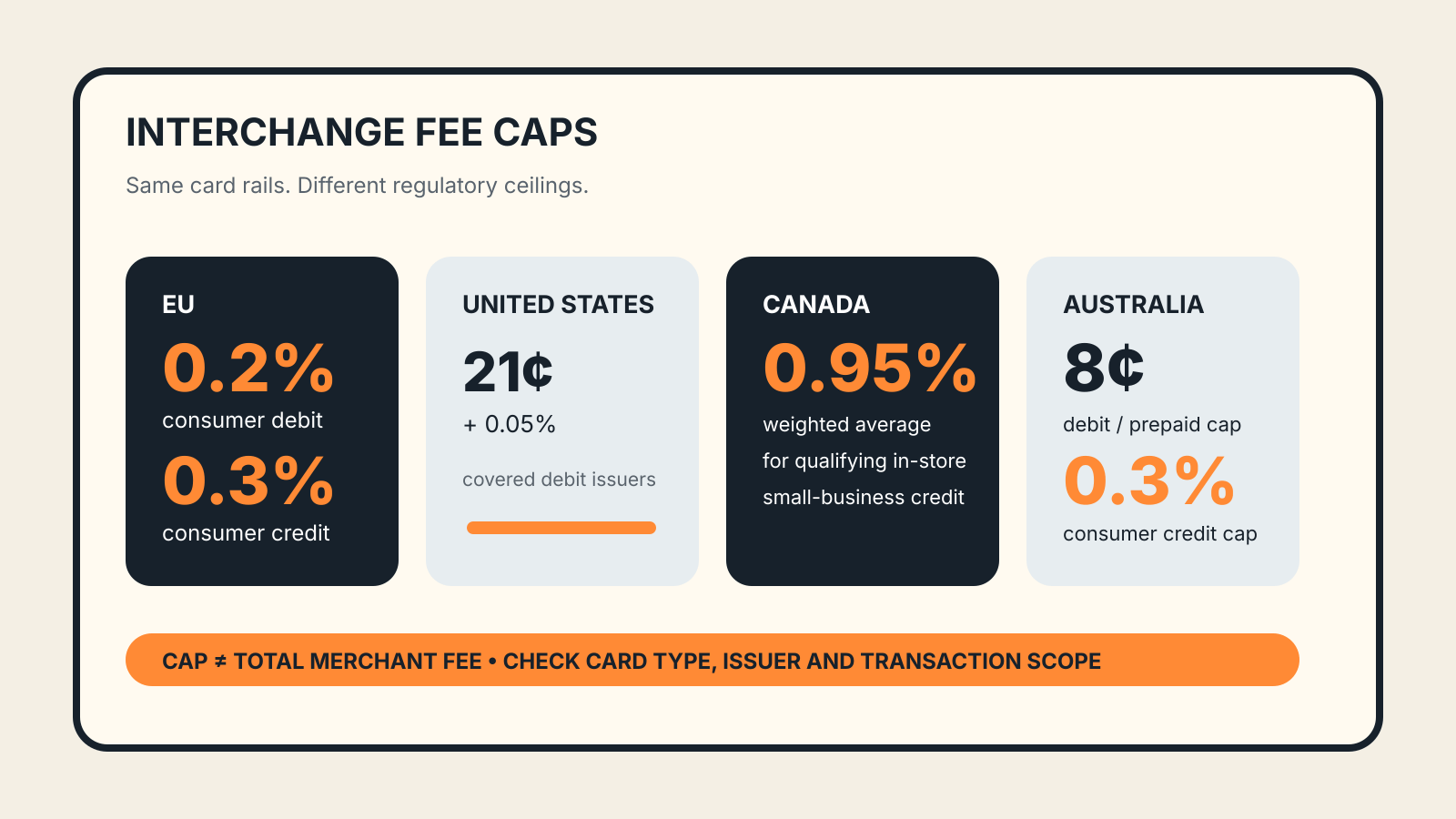
Regulation (EU) 2015/751 caps the per-transaction interchange fee at 0.2% of the transaction value for covered consumer debit-card transactions and 0.3% for covered consumer credit-card transactions.
The regulation allows member states to set lower domestic caps. It also contains exclusions and special rules, so a business card charged directly to a company account should not be assumed to receive the consumer-card cap.
For a €100 illustrative purchase, 0.2% is €0.20 and 0.3% is €0.30. Those figures describe the covered interchange component. They do not include every fee a merchant may pay.
United States: a formula for covered debit issuers
Federal Reserve Regulation II applies an interchange standard to covered electronic debit transactions. The current rule states that a covered issuer complies when the fee is no more than 21 cents plus 5 basis points of the transaction value. A separate fraud-prevention adjustment may be available when the issuer meets the rule’s requirements.
Five basis points equals 0.05%. On a hypothetical $100 debit transaction, the base formula is therefore $0.21 plus $0.05, or $0.26, before any eligible fraud-prevention adjustment.
The rule has important scope limits. Certain small issuers, government-administered programs and qualifying reloadable prepaid cards are exempt from the fee limitation. Regulation II also addresses debit-routing competition; our debit-card routing explainer covers that separate requirement.
Credit-card interchange in the United States does not share this federal debit cap. Treating the debit formula as a universal US card-fee ceiling would be wrong.
Canada: lower rates for qualifying small businesses
Canada’s 2024 agreements with Visa and Mastercard reduced domestic consumer credit interchange for qualifying small businesses. The Department of Finance announcement says the in-store rate is an annual weighted average of 0.95%, while online interchange was reduced by 10 basis points.
Eligibility is assessed separately by network. The government states that businesses with annual Visa sales below C$300,000 qualify for Visa’s lower rates, while the Mastercard threshold is C$175,000. Eligible non-profits below those thresholds also benefit.
A weighted average is not a promise that every individual transaction carries exactly 0.95%. Card type and the network’s rate schedule can still affect a particular transaction. Merchants should compare their statements before and after qualification rather than multiply all sales by one headline number.
Australia: new caps took effect in October 2026
The Reserve Bank of Australia changed its payment-card standards on October 1, 2026. Its current debit and prepaid framework caps domestic debit and prepaid interchange at 8 Australian cents per transaction, or 0.16% when expressed as an ad valorem rate.
The credit-card framework caps domestic-issued consumer credit interchange at 0.30% and commercial credit interchange at 0.80%. The RBA says a 1.0% cap for foreign-issued card transactions begins April 1, 2027.
This is a good example of why date and card origin matter. A table copied from before October 2026 can show superseded ceilings, while the foreign-card rule has a future start date.
Illinois: a delayed rule with a narrower target
Illinois’ Interchange Fee Prohibition Act does not set a general percentage cap. The statute would prohibit interchange on the tax or gratuity portion of an electronic payment when the merchant transmits that amount as part of authorization or settlement. The Illinois General Assembly text now shows an effective date of July 1, 2027.
The law has also been the subject of federal preemption litigation. That makes it unsuitable for a simple “Illinois cap” row beside the national formulas. Merchants and payment providers should verify the effective date, current court orders and which entities a rule can reach before changing systems.
A compact comparison
| Market | Covered example | Headline limit |
|---|---|---|
| European Union | Consumer debit | 0.2% per transaction |
| European Union | Consumer credit | 0.3% per transaction |
| United States | Debit transaction at covered issuer | 21¢ + 0.05%, plus any eligible fraud adjustment |
| Canada | Qualifying small-business in-store consumer credit | 0.95% annual weighted average |
| Australia | Domestic debit and prepaid | 8¢, or 0.16% when percentage-based |
| Australia | Domestic consumer credit | 0.30% |
| Illinois | Tax or gratuity portion, if the delayed law applies | No interchange on that portion; effective date shown as July 1, 2027 |
The rows are not directly interchangeable. Some are hard per-transaction caps; one is a weighted average; one applies only to covered issuers; another excludes a transaction component rather than capping the whole fee.
How to check your own statement
Start with one month’s card sales and group transactions by network, card type and channel. Match the interchange line to the network’s current rate description, then separate network fees and processor charges. If pricing is bundled, ask the acquirer which part changes when an interchange rule changes.
Use the payment fee calculator for scenario work, but enter the full fee arrangement rather than the statutory interchange number alone. A cap can reduce one input without determining the final merchant cost.