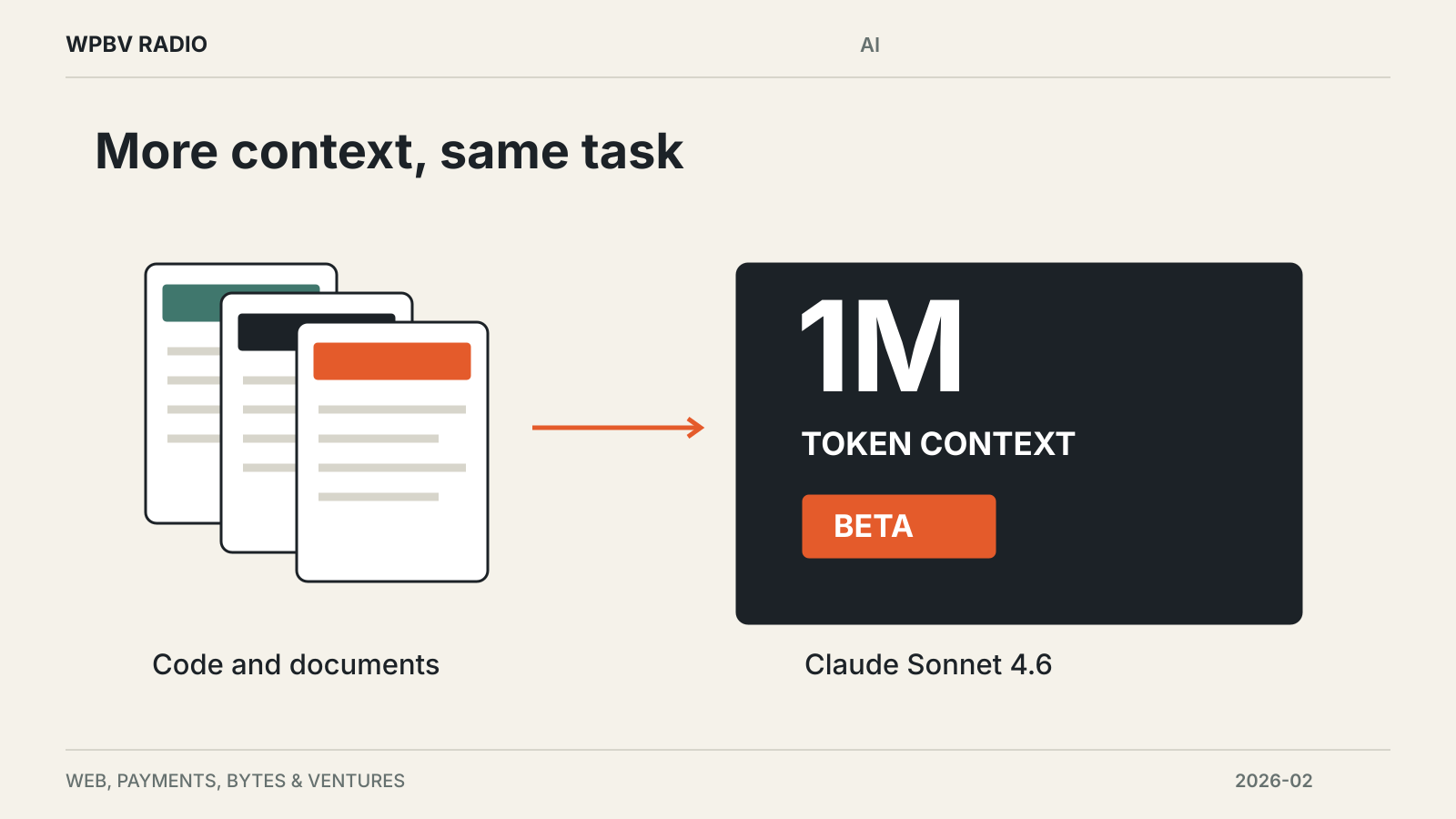
Anthropic released Claude Sonnet 4.6 on February 17, updating its coding, computer-use and document-reasoning capabilities. The model becomes the default for Free and Pro users in Claude and Claude Cowork, according to the company. A one-million-token context window is available in beta, expanding how much material supported workflows can place in a request.
The announcement says API pricing remains at Sonnet 4.5’s level, starting at $3 per million input tokens and $15 per million output tokens. Those starting rates should not be treated as a complete estimate for every workload or configuration.
A longer input changes what can fit
A larger context window can accommodate more source files or longer documents together. That reduces the need to choose a small excerpt before asking a question, although it does not guarantee that the model will use every detail correctly.
For a coding task, the useful result is a change that fits the surrounding application and passes relevant checks. For a document task, it is an answer that can be traced to the right passage. The input limit and the quality of those outcomes measure different properties.
Anthropic also introduces context compaction in beta on its platform, summarizing older material as a conversation approaches its limits. Applications using that feature need to account for the difference between original text and a summary of it.
Computer use still needs boundaries
Anthropic reports improvements in working through software interfaces and stronger resistance to prompt injection than the preceding Sonnet model. These are the vendor’s evaluations, not an independent assurance that an agent can safely complete any task unattended.
Computer use gives a model access to actions that a plain chat response cannot perform. A mistaken click in a test environment and a mistaken action in a live account have different consequences. Teams evaluating the release should therefore test the tasks, permissions and recovery steps that belong to their actual workflow.
The model’s capabilities extend beyond coding, but the right comparison remains local: does it finish the work with fewer corrections at an acceptable total cost? Follow the AI desk for model and agent coverage.