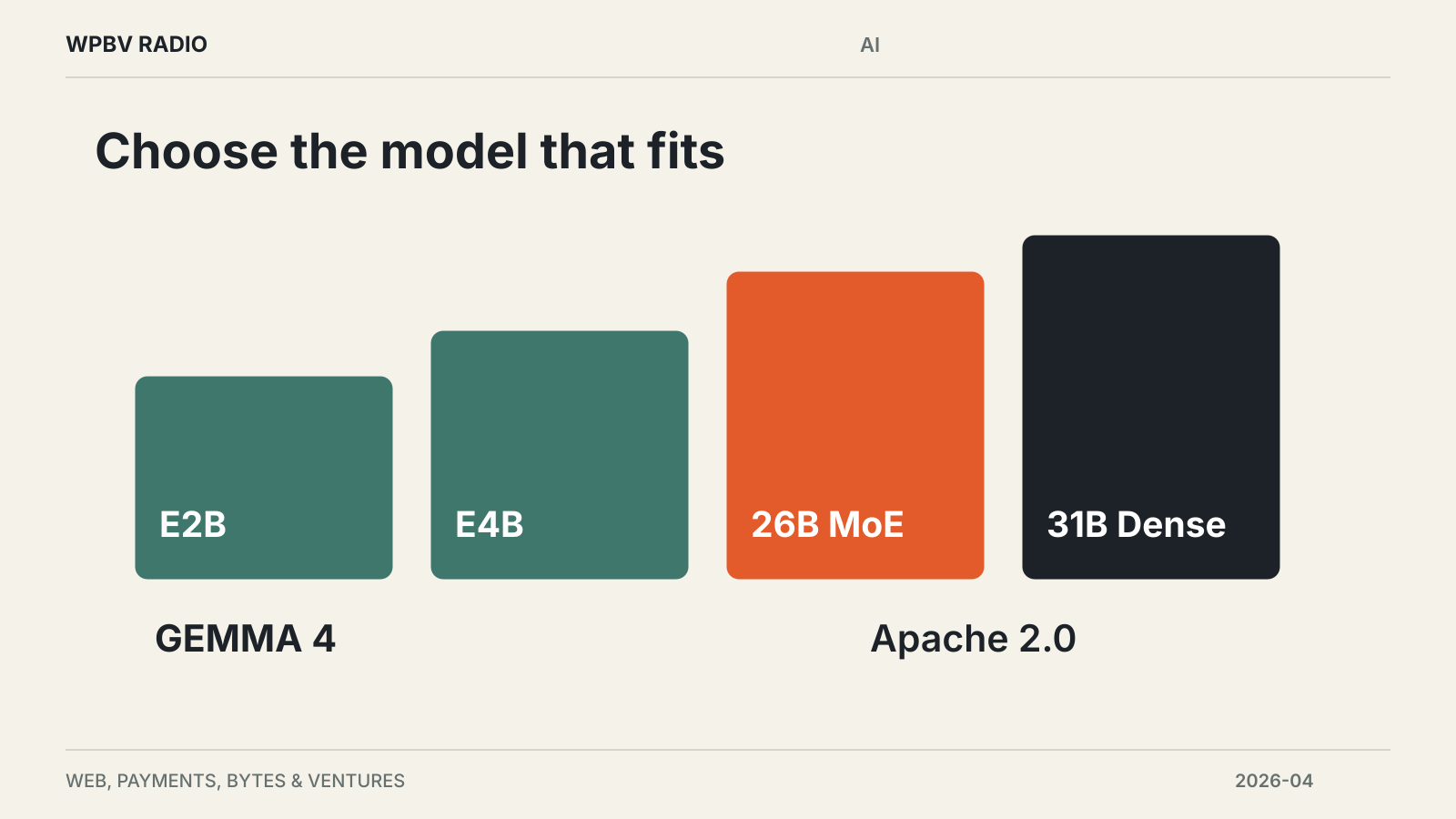
Google released Gemma 4 on April 2, making four sizes of its open model family available under an Apache 2.0 license. The lineup includes Effective 2B and Effective 4B models for smaller devices, a 26B mixture-of-experts model and a 31B dense model. Developers can choose weights that fit their hardware and intended workload.
In its launch post, Google describes support for reasoning, code generation, structured output and tool calling. All four models accept images and video, while the smaller E2B and E4B versions also support native audio input.
Model size is only the first hardware question
Google says the 26B mixture-of-experts version activates 3.8 billion parameters during inference. That can reduce the computation used for a token, but it does not turn the model into a 3.8-billion-parameter download: the full model still has to be stored and served.
The launch material describes unquantized larger models fitting on a single 80 GB H100 GPU, with quantized versions intended for consumer hardware. Developers should therefore distinguish a model’s parameter count, its memory footprint and the speed of the particular runtime they plan to use.
The E2B and E4B models target devices with tighter memory and power budgets. Google lists a 128,000-token context window for these versions and up to 256,000 tokens for the larger models. Longer input also consumes resources, so a maximum context figure is not a free performance upgrade.
Downloadable weights create deployment choices
Gemma 4 can run locally or in cloud infrastructure. Google lists day-one support across tools including llama.cpp, MLX, Ollama and vLLM, as well as access through Google services.
A local deployment can keep inference within infrastructure the developer controls. The surrounding application still determines where prompts, logs and tool results travel. Downloading a model does not automatically make every connected workflow private.
For a team evaluating the release, a useful trial is a small set of real tasks on the intended device. Check answer quality alongside memory use and response time before choosing between the smaller and larger models.
Find more model coverage at the AI desk.