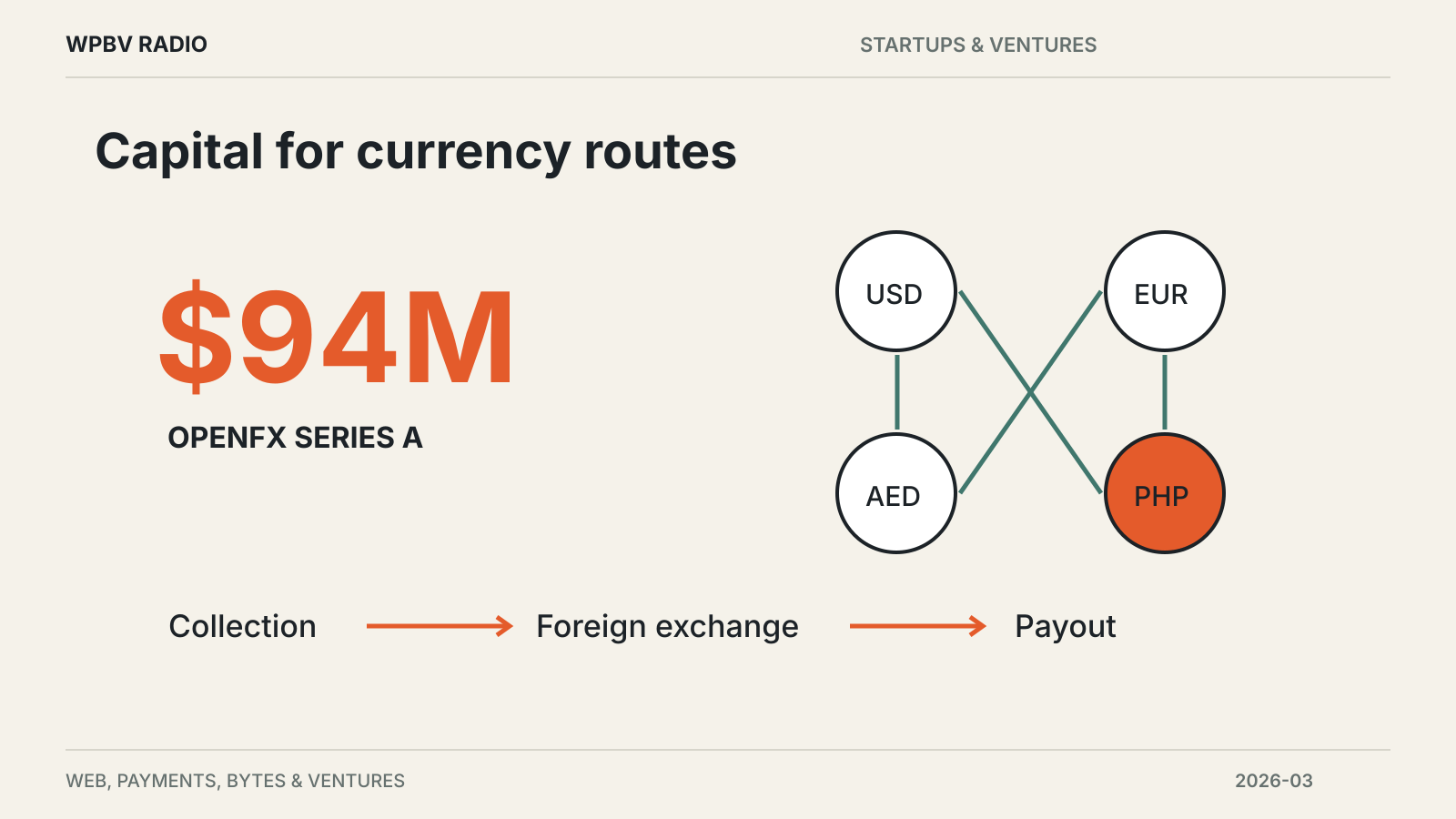
OpenFX announced a $94 million Series A on March 31 to expand its cross-border payments infrastructure for financial institutions. The company names Accel, Atomico, Lightspeed Faction, M13, Northzone and Pantera as leads. Its approach uses stablecoins between collection and payout while allowing the sender and recipient to deal in local currencies.
Founder Prabhakar Reddy sets out the investment and operating figures in the company’s funding announcement. OpenFX says its customers include fintechs, neobanks, remittance services and payroll processors.
The customer buys a payment route
OpenFX’s description starts with the sender paying local fiat currency. Value moves between markets using stablecoins, and the recipient receives local fiat. Neither end user needs to manage the intervening crypto asset.
That design places the difficult work inside the service: collecting funds, supplying foreign-exchange liquidity and completing the local payout. A fast blockchain transfer can help the middle step, while the beginning and end still depend on functioning local connections.
The company says it has built infrastructure for 15 currencies. Expanding coverage means adding usable liquidity and banking relationships, not merely displaying another currency code in an interface.
Company metrics need their proper labels
OpenFX reports more than $45 billion in annual payment volume, over 100 institutional customers and 98% of transactions settling in under 60 minutes. These are company-reported figures in the funding post, not independently audited measurements presented with the announcement.
Payment volume is also different from revenue. A service may move a large amount of customer money while retaining a much smaller fee. The funding post does not provide enough detail to calculate the business’s profitability or unit economics.
Reddy says the company will hire across engineering, product, operations and commercial functions. He also describes licensing, banking relationships and local liquidity as time-consuming work. Those details explain why institutional payment infrastructure can need substantial investment even when a transfer looks simple to the person sending it.
The Startups & Ventures desk covers the business decisions behind infrastructure products.