Lightning Labs released Taproot Assets 0.8 and the first public Taproot Assets SDK on June 23. The Go library gives developers a higher-level interface for issuing, sending and tracking assets through the Taproot Assets daemon. The release also adds wallet-backup options and changes to grouped assets and payment routing.
The release announcement says the SDK requires tapd version 0.8.0 or newer. It simplifies access to the protocol while still relying on the daemon that holds assets, builds transactions and manages proofs.
One reference replaces repeated identifier handling
An asset may be identified by a particular issuance or by a group key linking interchangeable units from several issuances. Application developers previously had to keep those distinctions in view across many calls.
The SDK introduces an AssetRef value that selects the appropriate underlying identifier when it talks to the daemon. The same reference can be used for balances, transfers, proofs and other operations.
The library also keeps asset types separate: a fungible asset is different from an issuance, and a collection is different from an individual collectible. That preserves useful distinctions while reducing repeated bookkeeping in application code.
Smaller backups require more reconstruction
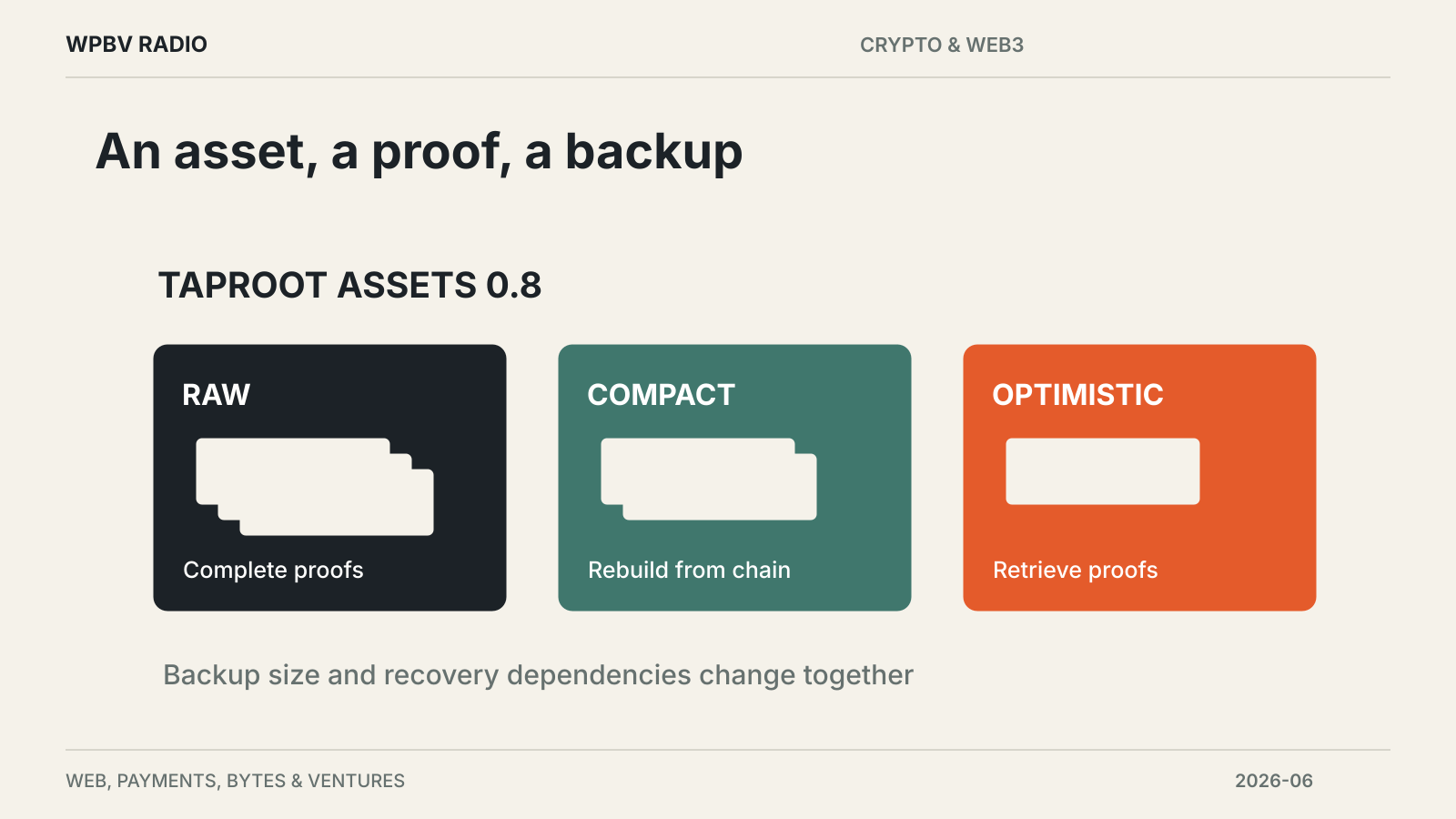
Version 0.8 offers three backup modes. Raw backups include complete proof files. Compact backups remove fields that can be reconstructed from the blockchain. Optimistic backups omit proofs and retrieve them from a universe federation during restoration.
The choice trades file size against what must be available and rebuilt later. The smallest backup is therefore not necessarily the most self-contained recovery option.
Lightning Labs adds an important boundary: these backups cover the Taproot Assets layer. A full restoration still requires access to the corresponding LND wallet. Operators should test the complete recovery process, including that dependency, rather than assuming a single export contains everything.
The release also lets operators burn grouped assets by group key and improves forwarding-history records. Those changes make the infrastructure easier to operate as well as easier to call from an application.
More network and wallet reporting is available at the Crypto & Web3 desk.