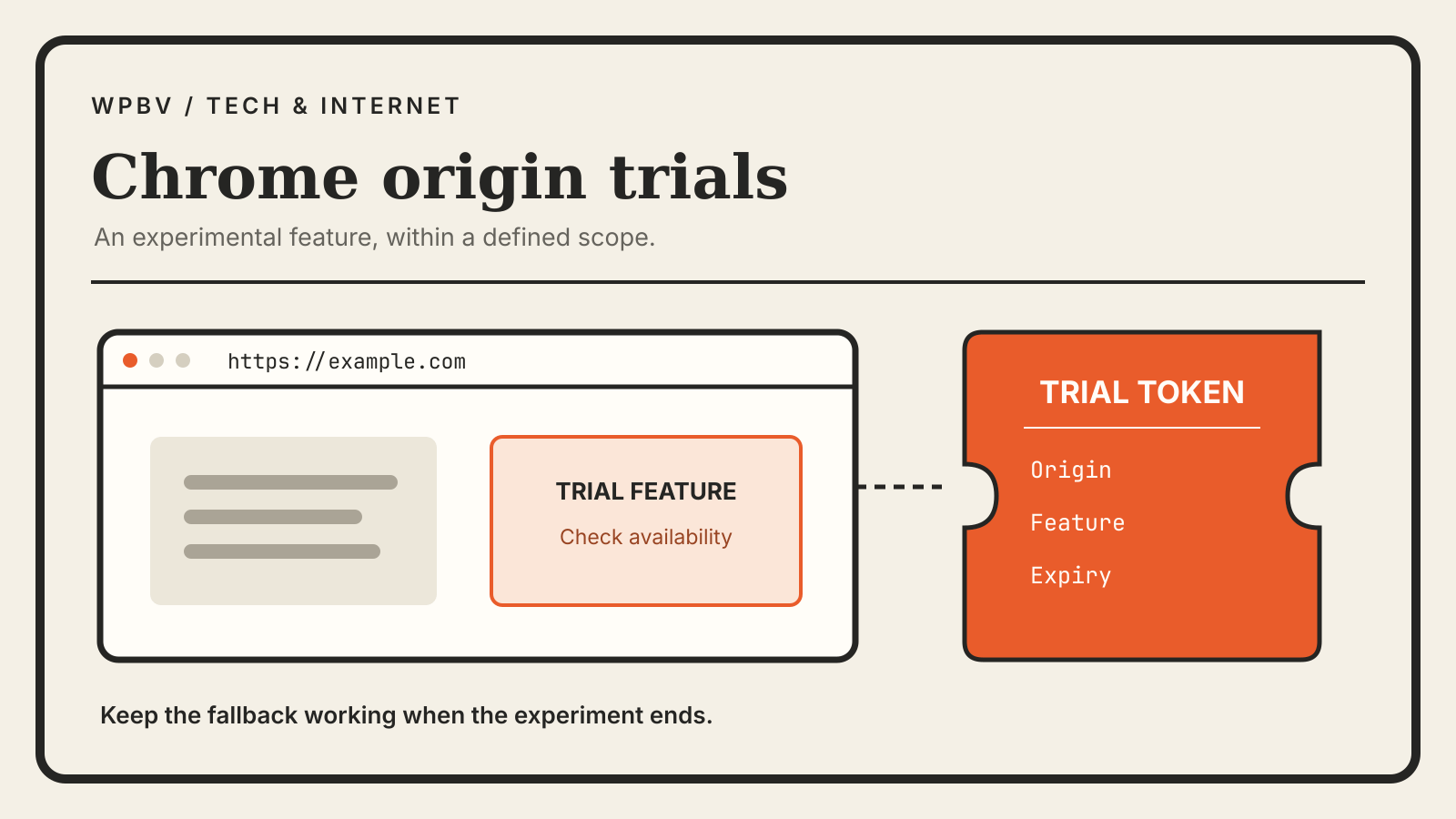
Chrome origin trials let a website try an experimental browser feature with real visitors for a limited period. A registered token enables participation within a defined scope; browser support, expiry and a working fallback still need separate checks.
A trial can help a team answer a specific product question before depending on a new API. Can users complete a task more easily? Does the fallback still work? Treat the experiment as a temporary part of the product, with someone responsible for removing or updating it.
Documentation checked: October 21, 2026. This guide covers the trial process, not a promise that any particular API is currently available.
What a Chrome origin trial enables
In Google’s getting-started documentation, a developer registers an origin for an eligible experimental feature and receives a token. The site supplies that token to enable participation. Visitors do not normally need to turn on a browser flag themselves.
The registration is specific to the experiment. It does not grant access to every upcoming browser feature, and a trial does not establish that an API will become a permanent web standard. Google uses feedback from trials when deciding what happens next.
An origin trial also differs from choosing a browser release channel. A channel determines the browser build a person runs; a trial controls participation in a particular experiment on a registered origin. Our browser release channels explainer covers Stable, Beta, Dev and Canary.
Start with the question you want to answer
Suppose a team wants to evaluate a browser feature that could shorten one step in a form. A useful experiment would compare task completion and errors while retaining the existing form as the fallback. This is a hypothetical design, not a test we conducted.
Write down the decision before integrating the API. For example: continue only if the new route handles the required use cases and the old route remains usable when the feature is unavailable. Avoid making trial enrollment itself the success metric.
Choose a narrow surface first. An optional enhancement is easier to remove than a dependency embedded throughout account creation, payments and support. Record which pages use the experiment so the eventual cleanup has a defined scope.
Register and deploy the right token
For ordinary first-party participation, Chrome documents a token supplied through an HTML origin-trial meta tag, an Origin-Trial HTTP response header, or JavaScript. Follow the feature’s own instructions when selecting the method.
Before release, make a small deployment record:
| Record | What the team should save |
|---|---|
| Experiment | Feature name and official trial documentation |
| Scope | Exact origin and pages intended to participate |
| Availability | Supported browser versions and platforms |
| Ownership | Person responsible for feedback, renewal and removal |
| Exit | Fallback behavior and a date to review the experiment |
Keep configuration review separate from product review. A correctly delivered token answers whether the site enrolled successfully. It does not answer whether the feature is useful to visitors.
Diagnose availability before blaming the API
Chrome’s troubleshooting guide describes several independent checks: the browser and version must support the trial, the token must be valid, and its origin must match the expected context. Scheme, hostname and port can matter to that match.
Inspect the relevant frame in the DevTools Application panel. A WrongOrigin result points toward the registered context or deployment method; an Expired result calls for checking validity dates. A trial can also be unavailable to a particular user. Feature detection remains necessary even when enrollment appears correct.
For an internal bug report, capture the page origin, browser version, token status and affected step. That gives the next developer something concrete to investigate. A report that says only “works on my laptop” cannot distinguish a version difference from a configuration problem.
Use the site’s browser version tracker for release context, then consult the trial’s own supported-version details. Do not infer support in every Chromium-based browser from success in Chrome.
Embedded scripts need a different enrollment decision
Some experiments support third-party origin trials, which let an embedded script provider participate across multiple sites. The option is offered only for suitable features.
A third-party token must be injected by an external JavaScript file whose origin matches the registration. Putting that token directly in static HTML, an inline script or a response header does not meet the documented third-party deployment requirement.
That distinction matters when an integration spans a website owner and an SDK provider. Agree who registers, where the script is served and which customers are included. Chrome’s guidance places responsibility on the provider to notify partners or customers about participation and experimental behavior.
Avoid enabling an experiment across every customer by default merely because one shared script makes that convenient. An agreed test group, an owner and a removal path make the result easier to interpret and support.
Read the feature’s current notes as well as the overview
A general guide cannot capture every experiment’s restrictions. Google’s October 5, 2026 email-verification update illustrates this: it describes third-party trial support from Chrome 154, with a specific requirement connecting the registered origin to the issuer’s site. It also documents backwards-incompatible changes.
The lesson for a rollout is practical. Save the exact documentation version or check date used during implementation, and revisit the feature’s own changes before widening participation. A generic third-party enrollment tutorial would not be enough to validate that particular integration.
Plan the end before the trial expires
Track the token’s validity and the trial’s end separately. Check the current registration rather than assuming every experiment lasts a fixed number of weeks. Google’s getting-started guide explains that an extended trial can require renewed registration and replacement tokens; expired tokens are ignored.
Put the review date in the team’s normal release process. At that review, decide whether to renew, migrate to the shipped API if one exists, or remove the experimental route. Exercise the fallback deliberately before the deadline, while someone is available to fix it.
If the experiment ends without shipping, the product should still have a usable route through the task. That is the condition to preserve throughout the trial.