
CVSS rates how severe a software flaw could be, EPSS estimates the chance it will be exploited in the next 30 days, and the CISA KEV catalog lists flaws already known to be exploited. They answer three different questions. Check KEV first, use EPSS to sort what is left, and read CVSS for the damage a successful attack would do.
Last checked November 25, 2026. The counts below come from CISA’s KEV file (catalog version 2026.11.24), FIRST’s EPSS scores dated November 24, 2026, and the National Vulnerability Database (NVD). Vulnerability data changes every day, so read the numbers as a snapshot.
What each score measures
- CVSS is a severity rating from 0 to 10. FIRST’s CVSS 4.0 specification calls it “an open framework for communicating the characteristics and severity of software vulnerabilities.” The Base score describes the flaw itself. Optional Threat, Environmental and Supplemental metrics adjust it for exploit code, your own setup and extra context. Most published scores are base scores, and FIRST’s EPSS FAQ quotes the CVSS 4.0 FAQ on this point: “CVSS-B Base scores are not risk.”
- EPSS is a probability from 0 to 1 that exploitation activity will be seen against a vulnerability within the next 30 days. FIRST publishes a score for every CVE and refreshes it daily. FIRST also says EPSS is not a complete risk score: it does not measure how much damage an attack would do or whether the flaw affects your systems.
- KEV is CISA’s Known Exploited Vulnerabilities catalog. It is a list, not a score: a CVE is in it or it is not. The file for November 24, 2026 held 1,795 entries, each with the date added, a due date and a required action.
How the three look across all vulnerabilities
- KEV is small. It holds 1,795 entries, against 411,908 CVEs scored by EPSS. That is about 0.4%. CISA added 29 entries between November 1 and November 24.
- EPSS clusters near zero. Of the 411,908 scored CVEs, 36.5% (150,342) have a score of 1% or higher, 4.3% (17,783) have 10% or higher, and 1.1% (4,446) have 50% or higher. FIRST’s FAQ puts the observed base rate of exploitation at around 2 to 3%.
- Most KEV entries score high on EPSS, but not all. Of the 1,794 KEV entries with an EPSS score, 97.0% sit at 1% or above and 75.4% at 10% or above. The median is 0.54. About one in four is below 10%.
- A Critical rating does not predict KEV. NVD lists 67 CVEs with a Critical CVSS v3 rating that were published from October 1 to 20, 2026. Two of them are in KEV, with EPSS scores of 0.58 and 0.76. Of the 67, 58 have an EPSS score below 1% and 65 are below 10%.
- KEV entries are not all Critical. Of the 28 KEV additions from November 1 to 24 that NVD had a CVSS v3.1 score for, 13 scored 9.0 or higher and 4 scored below 7.0 (6.5, 6.5, 5.5 and 4.3). Seventeen of the 28 had an EPSS score below 10%.
Five real CVEs, three different answers
- Log4Shell (CVE-2021-44228). CVSS 10.0, EPSS 99.999%, in KEV since December 10, 2021. All three agree: patch.
- SAP NetWeaver (CVE-2025-42884). CVSS v3.1 6.5, Medium. EPSS 0.9%. CISA added it to KEV on November 20, 2026, with a due date of November 23. Only the KEV listing marks it as urgent.
- OpenSSH (CVE-2026-123158). CVSS v3.1 8.1, High, not Critical. EPSS 95.5%. Added to KEV on November 9 with a due date of November 12. Both exploitation signals say urgent.
- Optimizely Web Experimentation (CVE-2026-132224). CVSS v3.1 8.7. EPSS 0.4%. Added to KEV on November 24, the day of the EPSS file used here. FIRST’s FAQ says that when direct evidence of active exploitation exists, that evidence should supersede EPSS.
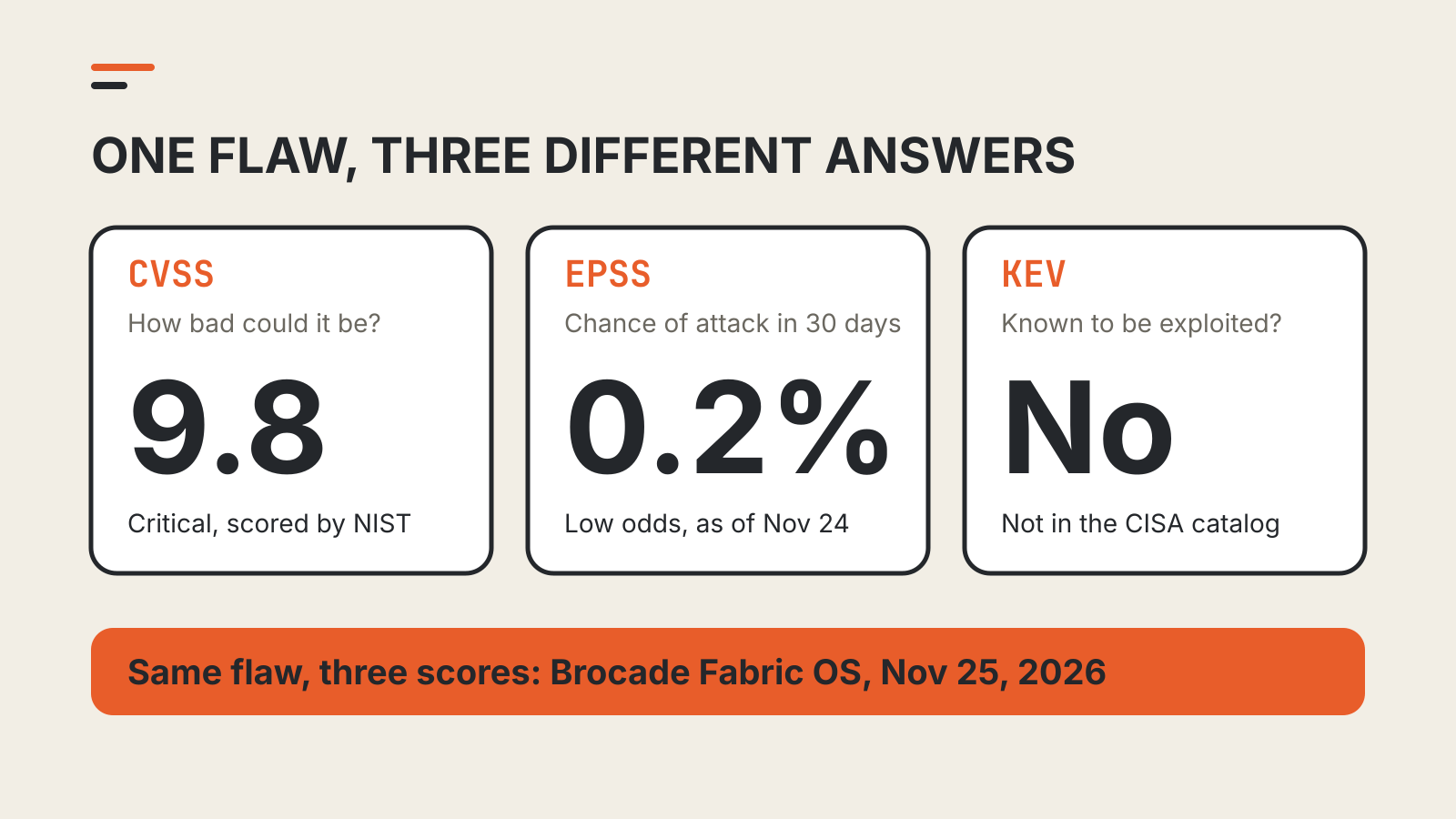
- Brocade Fabric OS (CVE-2026-87659). Published October 8, 2026. NIST scored it 9.8 under CVSS 3.1, with a network attack vector and no privileges required. Brocade’s own CVSS 4.0 score is 7.1, with a local vector and high privileges required. EPSS is 0.24% and it is not in KEV. The same flaw gets two scores from two scorers on two versions.
What the KEV due dates show
CISA announced Binding Operational Directive 26-04, Prioritizing Security Updates Based on Risk, on June 10, 2026. It applies to federal agencies, and CISA’s announcement lists KEV status and asset exposure among the factors for ranking remediation. The announcement does not mention CVSS or EPSS.
The KEV file records each deadline. Of the 178 entries added from June 10 to November 24, 2026, 140 were due 3 days after they were added and 38 were due after 14 days. Of the 186 entries added during 2024, 175 had 21 days. The deadlines bind federal agencies, but anyone can read them as CISA’s own urgency signal for a listed flaw.
A practical order of checks
- Is it in KEV? If yes, and you run the product, treat it as urgent.
- Is the product exposed? An internet-facing system or one reachable by untrusted users goes ahead of an internal one.
- Look up EPSS. As a rule of thumb from the distribution above (not FIRST guidance), 10% or higher puts a CVE in roughly the top 4% of scored flaws, so schedule it early. Below 1% can follow your normal patch cycle unless KEV says otherwise.
- Read the CVSS vector, not just the number. Network or local, privileges needed, user interaction: these show what an attacker needs. Note who scored it and which version.
- Apply the vendor fix, or its documented mitigation when no patch exists.
Teams that keep an inventory find step 1 much easier. A software bill of materials tells you which components a product ships, and a lock file shows which versions a build pulled in. For apps that update themselves in stages, see why an update can reach you days later in our staged rollout guide.
Look up one yourself
CISA publishes the KEV catalog as a JSON file, and FIRST serves EPSS scores through a public API. For example, this request returns the EPSS score and percentile for Log4Shell:
curl "https://api.first.org/data/v1/epss?cve=CVE-2021-44228"
NVD’s CVE API returns the CVSS scores, with the source of each, for the same identifier. Compare the three before deciding what to patch first.