The GraphQL Technical Steering Committee announced the GraphQL over HTTP specification on November 12, 2026. The document sets out how a GraphQL service should use HTTP: a new response media type, application/graphql-response+json, and rules for which status code goes with which kind of response. The main GraphQL specification stays transport agnostic, so this is a separate, supplementary document.
What the committee published
According to the announcement, the main GraphQL specification, first released in July 2015, describes how a service takes a request, executes it and produces a response, and leaves the transport to implementers. Because HTTP is the most common transport, the missing shared rules made it harder for GraphQL services to work with other HTTP tools and harder to observe.
The new specification documents practices already in use: the URL, GET and POST requests, JSON encoding and headers. It adds the new media type and status code guidance, plus non-normative notes on security, partial success and future compatibility.
The new media type
Many servers have answered with application/json. A client then could not easily tell a valid GraphQL response from an error page produced by a proxy, a cache or another intermediary. The announcement says that when a client receives an application/graphql-response+json body, it can parse it as a well-formed GraphQL over HTTP response regardless of the status code.
The specification also covers older clients. A client that sends an Accept header with application/json and not the GraphQL type is still served, but a response with a 2xx status replaces the Content-Type header with application/json. A new client should list both types, and the spec suggests application/graphql-response+json, application/json;q=0.9 when it does not know what the server supports.
Which status code goes with which response
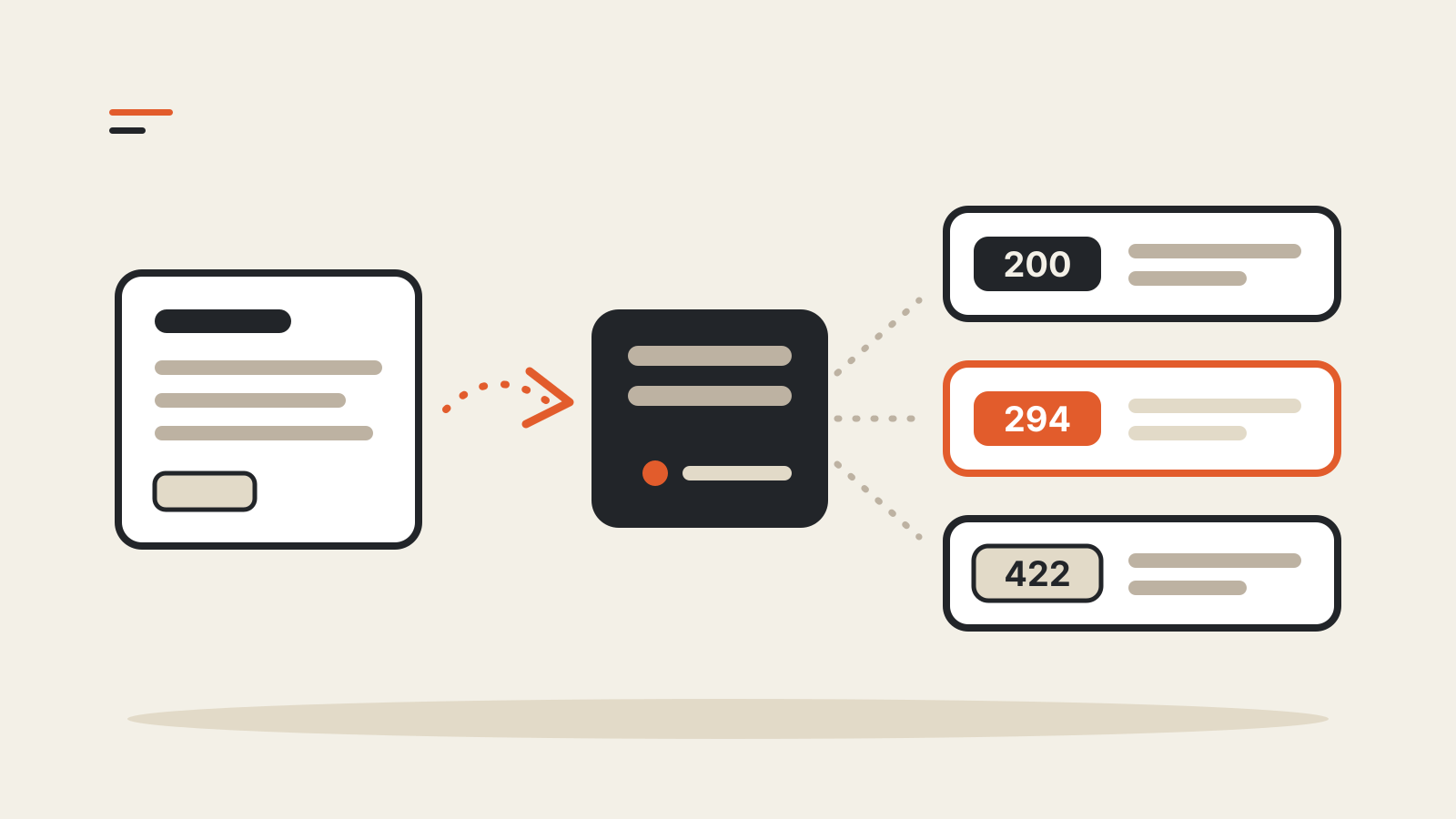
The announcement states the general rule in two lines: if the request returned data, return a 2xx status code; if it returned only errors, return a 4xx or 5xx. The spec text below is from its Status Codes section (5.4), where each row is marked SHOULD or MUST.
| Case | Status code | Requirement |
|---|---|---|
| Response has data and no errors | 200 | SHOULD |
Response has non-null data | any 2xx | MUST |
Response has no data entry (a request error) | 4xx or 5xx | MUST |
| Document cannot be parsed | 400 | SHOULD |
| Request fails validation | 422 | SHOULD |
| Variable coercion fails | 422 | SHOULD |
| Operation cannot be determined | 422 | SHOULD |
| Data with errors (partial success) | 294 | SHOULD |
The announcement’s own examples show a validation failure returned as 422 Unprocessable Content with an errors list and the new media type. It also lists other codes that can fit: 405 for a mutation sent over GET, 406 for an unsupported media type requested, 415 for an unsupported media type provided, 431 for excessively large headers and 500 for a server error.
If a server cannot produce a well-formed GraphQL response at all, the spec says it should answer with a suitable 4xx or 5xx status and must not use the GraphQL media type. That is what lets a client treat the media type as a signal that the body came from the GraphQL service rather than something in between.
294 is a custom code
The announcement lists a “294 Partial Success” status for responses that carry both data and errors. In the specification (section 6.1) this is a recommendation, not an IANA-registered code, and the spec ties it to the GraphQL media type. A client that does not recognize 294 must treat it as 200 OK under RFC 9110. The spec adds a warning for implementers: infrastructure may handle a 294 differently from a 200, so caching and header behavior should be checked before relying on it.
One point the spec leaves open: section 5.4 maps null data with errors to 294, while section 5.4.1 says field errors without a request error should get 200 OK. The text does not reconcile the two, so two compliant servers could reasonably return different codes for the same response. Teams that depend on status codes for monitoring should test what their own server returns.
GET and security rules
- GET parameters go in the URL query component. The
variablesandextensionsvalues, when present and non-empty, are JSON strings. - GET must not be used to execute mutations. The server should return a
4xx, with 405 recommended, and a 405 needs anAllowheader. - The spec warns that
multipart/form-dataandapplication/x-www-form-urlencodedcan produce “simple” browser requests that skip a preflight check, which opens a CSRF risk.application/jsonneeds a cross-origin preflight. - It describes a community pattern of requiring a custom header such as
GraphQL-Require-Preflightto force a preflight. That header is not a standard. - HTTPS, rate limiting, authentication, query size limits and timeouts remain the implementer’s job.
What comes next
The committee names three open items for a later revision: support for the QUERY HTTP verb, which the announcement says the IETF moved to proposed standard as RFC 10008, a standard approach to persisted documents, and request batching. Each has an open pull request on the project’s repository.
What the announcement does not say
- Adoption. The post says most GraphQL frameworks and libraries already support the specification but names none. Check a library’s release notes for the version that adds the new media type.
- Migration. There is no timeline for retiring
application/jsonresponses and no instruction for how a client should treat them beyond the content negotiation rules above. - Existing clients. The post does not say what happens to a client that expects
200for every response. The spec’sAcceptrules are the place to look.
For readers following how HTTP status codes behave in practice, see our explainers on HTTP 429 and Retry-After and HTTP 304 Not Modified.