
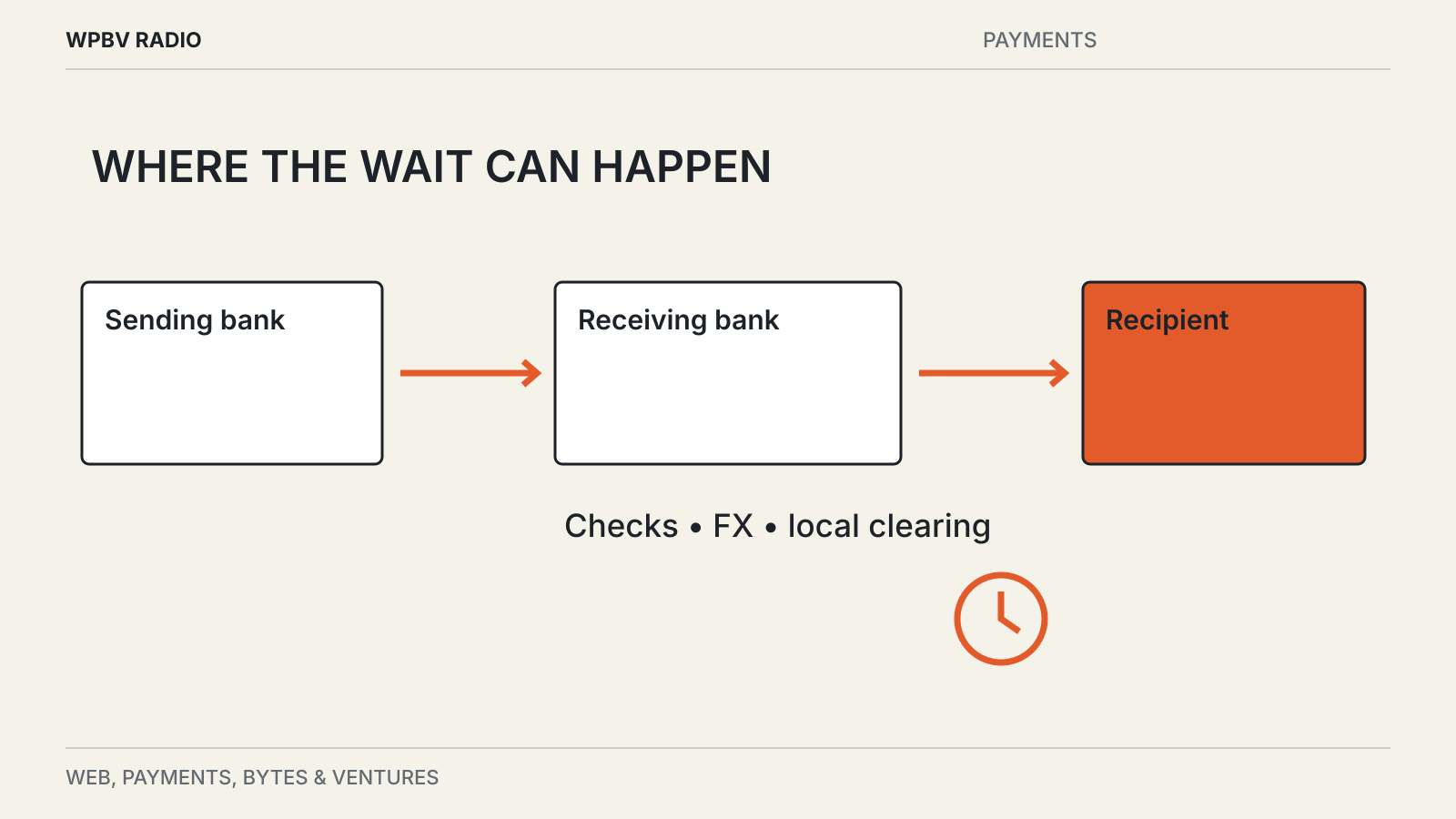
Your bank says an international transfer has been sent. The recipient checks the account and sees nothing. Both screens may be reporting their own part of the process correctly.
Moving a payment instruction between institutions and making money available to a customer are separate events. The delay can sit after the instruction reaches the receiving institution, where local processing, checks and currency arrangements still have to finish.
“Sent” describes the sender’s stage
A status label is only useful when its definition is clear. It might mean your bank accepted the request, debited your account or handed the instruction to another institution. It does not necessarily mean the beneficiary can spend the money.
Ask for a transaction reference and the expected delivery window. For an international transfer, also confirm the recipient’s name, account identifier, currency and any required payment purpose. A missing or inconsistent field can turn an automated process into a manual investigation.
Keep the confirmation and any tracking information together. If support teams on both sides need to investigate, a shared reference is more useful than screenshots with only a date and amount.
The final institution can be the slow part
In research published in July 2026, Swift identifies several sources of delay after a payment reaches the beneficiary institution: regulatory requirements, foreign-exchange conditions, inconsistent standards, risk controls and domestic payment infrastructure.
That finding helps explain an apparently contradictory experience. A fast cross-border network can deliver information efficiently while the local account-crediting process remains slow.
The remaining work may include matching the payment to the right customer, applying checks, converting currency and passing through a domestic clearing system. Some systems operate continuously; others depend on cutoffs or batches. A public holiday at one end can matter even when the other country has a normal working day.
More than one institution may be involved
Banks do not all hold direct accounts with every other bank in every currency. A transfer can therefore use intermediary relationships. Each handoff needs consistent instructions and a route for the funds.
The exact path is specific to the payment. It is unhelpful to assume every international transfer crosses a long chain of correspondent banks, just as it is unhelpful to assume every branded “instant” service uses the same infrastructure.
Some providers pay recipients from local funds and reconcile their positions separately. Others pass the payment through a more traditional route. The customer-facing delivery promise is what you should compare, together with fees and the recipient amount.
What to do when the expected window passes
Begin with the sending provider, using its published support channel. Ask which stage is complete, which institution currently needs to act and whether any information is missing.
Then ask the recipient to contact the receiving institution with the same reference. Do not send another payment solely because the first is not visible; a duplicate can create a second problem.
A trace or investigation can take time. Record the case number and the next update promised by the provider. If the payment is returned, compare the returned amount and currency with the original instruction, since fees or exchange-rate movements may affect the outcome.
Faster technology addresses only part of the route
A blockchain or a faster bank rail can shorten one stage without removing all the work around it. The recipient may still need conversion, identity checks and a bank payout. Our stablecoin fee guide explains why comparing only the transport layer misses part of the customer’s experience.
For businesses, the useful performance measure is when the recipient can use the funds, supported by clear tracking. A message delivered in seconds is valuable, but it is not the same metric.