
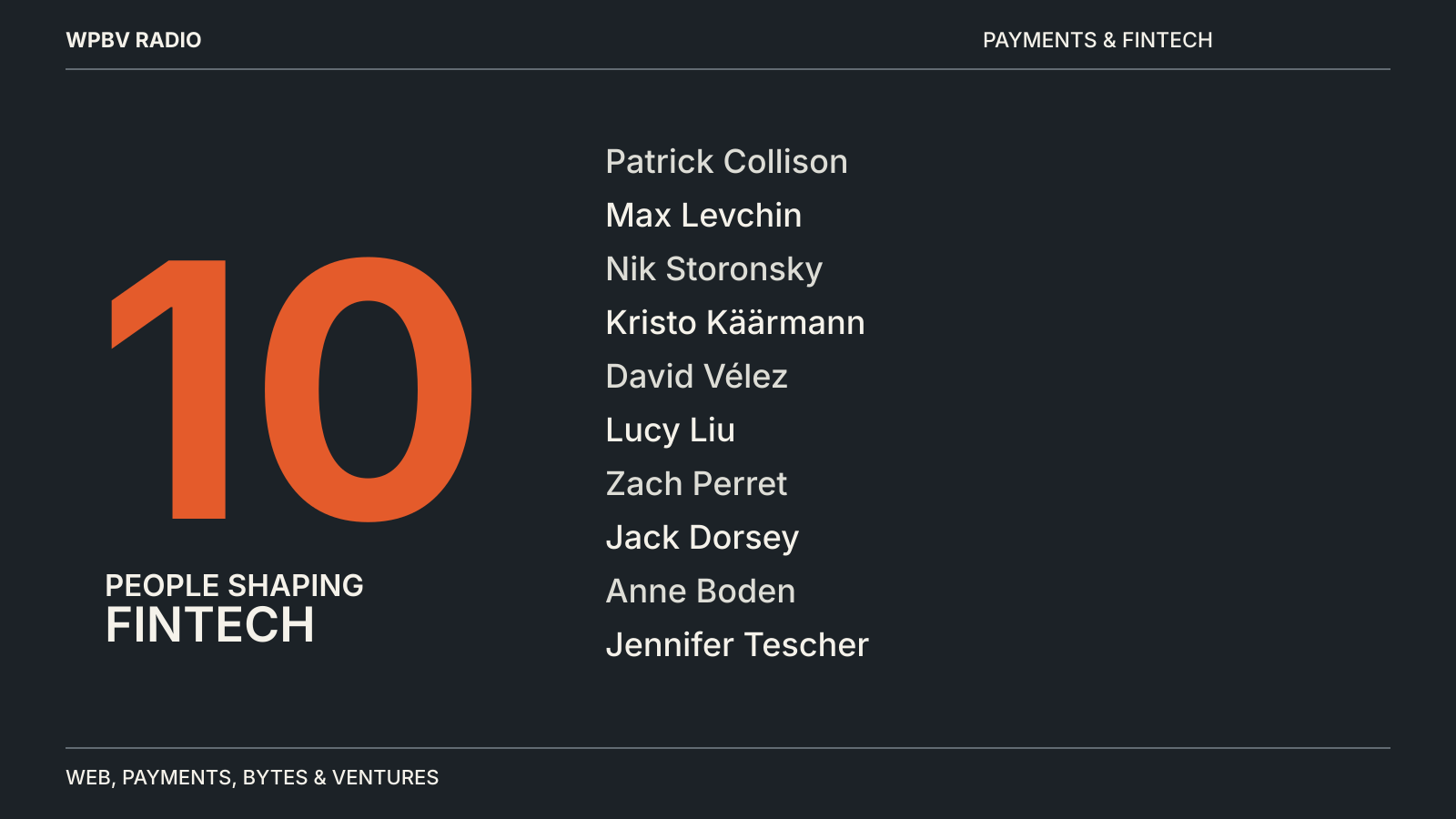
Fintech is often presented as a contest between apps. The more interesting story is how people change the systems behind them: accepting a payment, connecting an account, moving money across borders or deciding whether a financial product actually helps its customer.
These ten people provide different ways into that story. Some run large companies; others matter because of the institutions or ideas they helped build.
How we chose the list
This is an editorial selection, not a numerical ranking, a wealth list or an endorsement of the companies mentioned. We looked for contributions to payment infrastructure, access to financial services, product design and financial health, with examples spanning several markets.
The list includes founders whose continuing influence comes partly from earlier work. We describe those contributions separately from current company roles. It is not exhaustive: regulators, researchers, operators and less-visible infrastructure teams also shape the industry.
Patrick Collison — making payments a software problem
Collison co-founded Stripe and is its CEO, according to the company’s leadership information. Stripe provides infrastructure that lets businesses incorporate payments and related financial functions into software.
His relevance extends beyond a checkout button. When financial capabilities become easier for developers to integrate, more software companies can build them into their products. That changes the distribution of financial services and the demands placed on their underlying infrastructure.
The question to follow is how far that integration goes: which financial operations become ordinary parts of running an internet business, and which remain difficult across borders?
Max Levchin — credit at the point of purchase
Levchin founded Affirm and serves as its CEO; he previously co-founded PayPal. Affirm’s management biography documents that history.
Affirm places credit decisions inside the shopping experience. That makes Levchin a useful person to follow when examining the relationship between merchant conversion, repayment terms and the customer’s understanding of a purchase.
The important product question is what people see before committing: the total cost, payment schedule and consequences of choosing credit. Growth in checkout financing is only part of the story; clarity and repayment outcomes matter too.
Nik Storonsky — the expanding financial app
Storonsky co-founded Revolut and is its CEO. Revolut’s company overview describes a product that spans multiple financial functions and markets.
His work represents an attempt to make one app the starting point for a broad financial relationship. That creates a different product challenge from building a narrowly focused payment tool: more services must remain understandable, supportable and consistent.
Watch how a broad app handles the less glamorous parts of scale, including customer support, account access and differences between countries. A coherent interface cannot remove every underlying operational difference.
Kristo Käärmann — the recipient amount as a product feature
Käärmann co-founded Wise and is its CEO, as listed on the company’s leadership page. Wise built its identity around cross-border money movement.
That work directs attention to a useful customer question: how much arrives at the other end? A headline transfer fee is incomplete without the exchange rate, delivery time and receiving currency.
For readers following Käärmann, the interesting development is the reach of cross-border infrastructure into other products. The best experience may eventually appear inside a customer’s existing bank or business software rather than require a separate destination app.
David Vélez — digital banking at large scale
Vélez founded Nubank and is its chairman and CEO, according to Nu’s management information. The company’s work makes Latin America central to any serious discussion of digital banking.
His place here reflects the challenge of turning a simpler financial interface into a large, durable customer relationship. Account opening is the beginning; credit, servicing and the handling of difficult situations determine much of the ongoing experience.
The question is how digital distribution changes access and cost while the institution takes on the responsibilities associated with a wider range of financial products.
Lucy Liu — the financial operations behind global business
Liu co-founded Airwallex. In an August 2025 company announcement, Airwallex identified her as co-founder and president.
Her work highlights the needs of businesses that operate across currencies and borders: collecting revenue, paying suppliers and managing financial operations through connected software.
That area is easy to overlook in a conversation dominated by consumer apps. A business needs reconciliation and operational control as well as a transfer. Watch how providers combine those functions without making the underlying charges and currency conversions harder to understand.
Zach Perret — connecting financial accounts to software
Perret co-founded Plaid, whose press information describes its role connecting financial accounts with applications.
Account connectivity changes what another product can do with a customer’s permission. It can support workflows that would otherwise involve manually entering account details or moving information between systems.
The corresponding question is control: what data is shared, for what purpose and for how long? As financial software becomes more connected, a useful interface must make access understandable and revocable. Connectivity is valuable when the customer can see the boundary around it.
Jack Dorsey — merchants, consumers and connected networks
Dorsey co-founded Block and is listed as Block Head and chairman on its leadership page. Block’s businesses include Square and Cash App.
His influence connects two sides of financial technology: tools used by merchants and services used directly by individuals. That makes the relationship between commerce, payments and consumer financial activity especially relevant.
Watch how a provider serves small businesses while expanding into a broader network of services. The everyday experience at the counter is still a useful test of an ambitious financial platform.
Anne Boden — building a bank around software
Boden founded Starling Bank in 2014 and stepped aside as CEO in June 2023, as her current biography records. She belongs on this list for that founding contribution, not as Starling’s current chief executive.
Her work is a reminder that a digital bank is more than a visual redesign of an account. The operating systems, service processes and organization behind the interface influence what the product can deliver.
For readers, the useful question is which improvements come from better software and which require deeper changes to how a financial institution works.
Jennifer Tescher — measuring financial health
Tescher founded the Financial Health Network, originally launched in 2004. The FDIC’s biography describes her work connecting financial services with consumer financial health.
Her inclusion broadens the definition of influence. More accounts, transactions or app downloads do not by themselves establish that people are better able to manage everyday needs and financial shocks.
The question to carry into any fintech story is what improved for the customer. Convenience matters, but so do resilience, clarity and the ability to meet obligations without a new problem appearing elsewhere.
Follow the work behind the names
The people on this list make more sense when the underlying systems are visible. Start with what happens after a card tap and why international transfers can still take days. Those mechanics help separate a useful product change from a polished announcement.